PHOTO QUESTIONS / 20 OCTOBER 2026
Why does my face look asymmetrical in photos?
A photo can make facial differences look more noticeable, but one rear-camera image cannot tell you how noticeable they are in real life. Close distance, head angle and an unfamiliar unmirrored view can change what you notice. A mirror flip alone does not make your face less symmetrical.
Start with the photo conditions before treating a picture—or a score—as a verdict about your face.
Watch: why photos can look uneven
English narration with English captions. Watch on YouTube.
1. “That back camera is brutal.” The feeling is real; the explanation needs care.
In an r/AskReddit thread about real-life asymmetry versus back-camera photos, one commenter wrote: That back camera is brutal
. The discussion includes very different personal impressions. That tells us what people worry about; it does not measure what strangers notice or establish how a camera works.
Source checked 20 October 2026. The accessible versions show relative timestamps, so we do not assign an unverified September publication date, vote count or “viral” label.
You might notice an eyebrow height or mouth corner in an unfamiliar orientation that you usually overlook in the mirror. That is different from proving the camera increased the underlying mismatch. The practical question is: did the picture change, did the way you looked at it change, or did the detector change?
2. Three different effects often get bundled into “the back camera”
Mirror reversal changes orientation, not the amount of geometric asymmetry
A horizontal flip puts the left side on the right. It does not stretch one eye, move a mouth corner relative to the rest of the picture, or add a new mismatch. You can verify this without a beauty score: reflect every point and the distances between corresponding points stay the same.
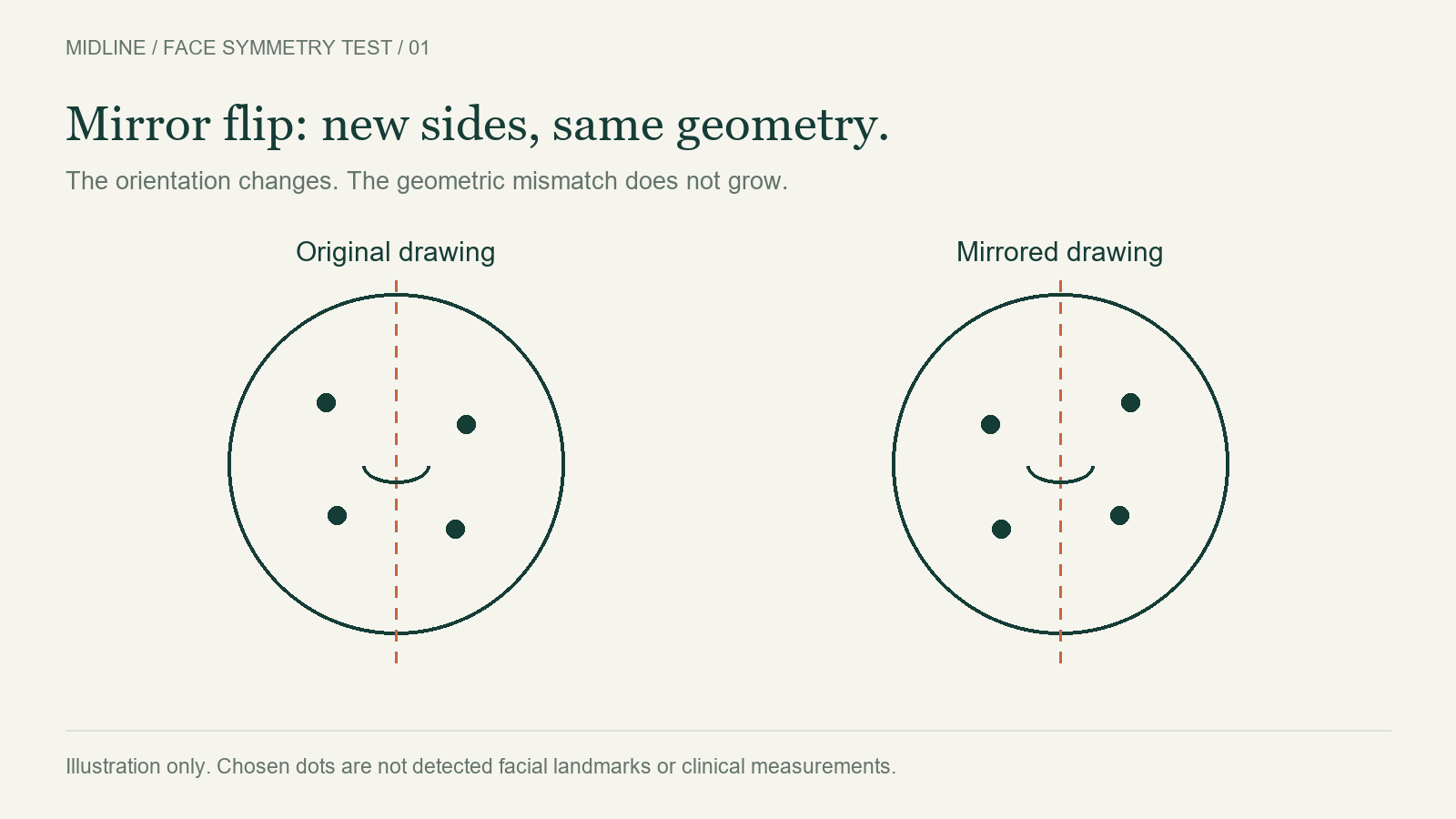
In coordinates, reflection about a vertical midline maps (x, y) to (−x, y). For two points, the squared distance remains (x₁−x₂)² + (y₁−y₂)², because changing the sign of the horizontal difference does not change its square. A symmetry comparison that reflects the points, midline and left/right labels consistently should preserve that geometric mismatch. This statement concerns geometry, not how a machine-learning detector responds to a newly flipped image.
Familiarity can change which view feels like “you”
If you usually see your face in a mirror, a non-mirrored image can feel unfamiliar. In Mita, Dermer and Knight’s 1977 study, participants tended to prefer their mirrored portraits, while friends tended in the opposite direction. This was a preference study with a limited participant group—not a test of which camera reveals everyone’s “true face,” or how visible your asymmetry is to others.
Camera position changes projection
A close camera does not see the same proportions as a farther camera. Features at different depths project at different scales. A small head turn also puts the two sides at different distances from the lens. Wide-angle lenses often make close framing convenient; that is not the same as saying focal length alone causes all perspective changes. Lens-specific distortion and software processing are additional issues, separate from a simple mirror flip.
Ward and colleagues’ 2018 mathematical study modeled how short-distance photographs alter apparent nose-to-face proportions. It supports taking camera distance seriously. It did not measure whether rear cameras universally increase facial asymmetry or how noticeable your particular face is in person.
Our transparent toy model: same points, different projection
To separate camera geometry from human perception, we projected three deliberately symmetric points—not a face. Their x coordinates are −1, 0 and +1, all at depth z=0 before turning. Focal scale is 1. We chose camera distances D=5 and D=15 in arbitrary model units, and turn angles θ=0° and θ=20°. These are illustration inputs, not recommended photo distances or acceptable head-angle thresholds.
For each point we calculate u = x cos(θ) ÷ [D − x sin(θ)], with the center projected to u=0. The table uses those chosen inputs, with output rounded to six decimals. When the points turn, the denominators on the two sides differ. The projected spacing can become unequal even though the source points are symmetric. This is a model demonstration, not a measured change in a person.
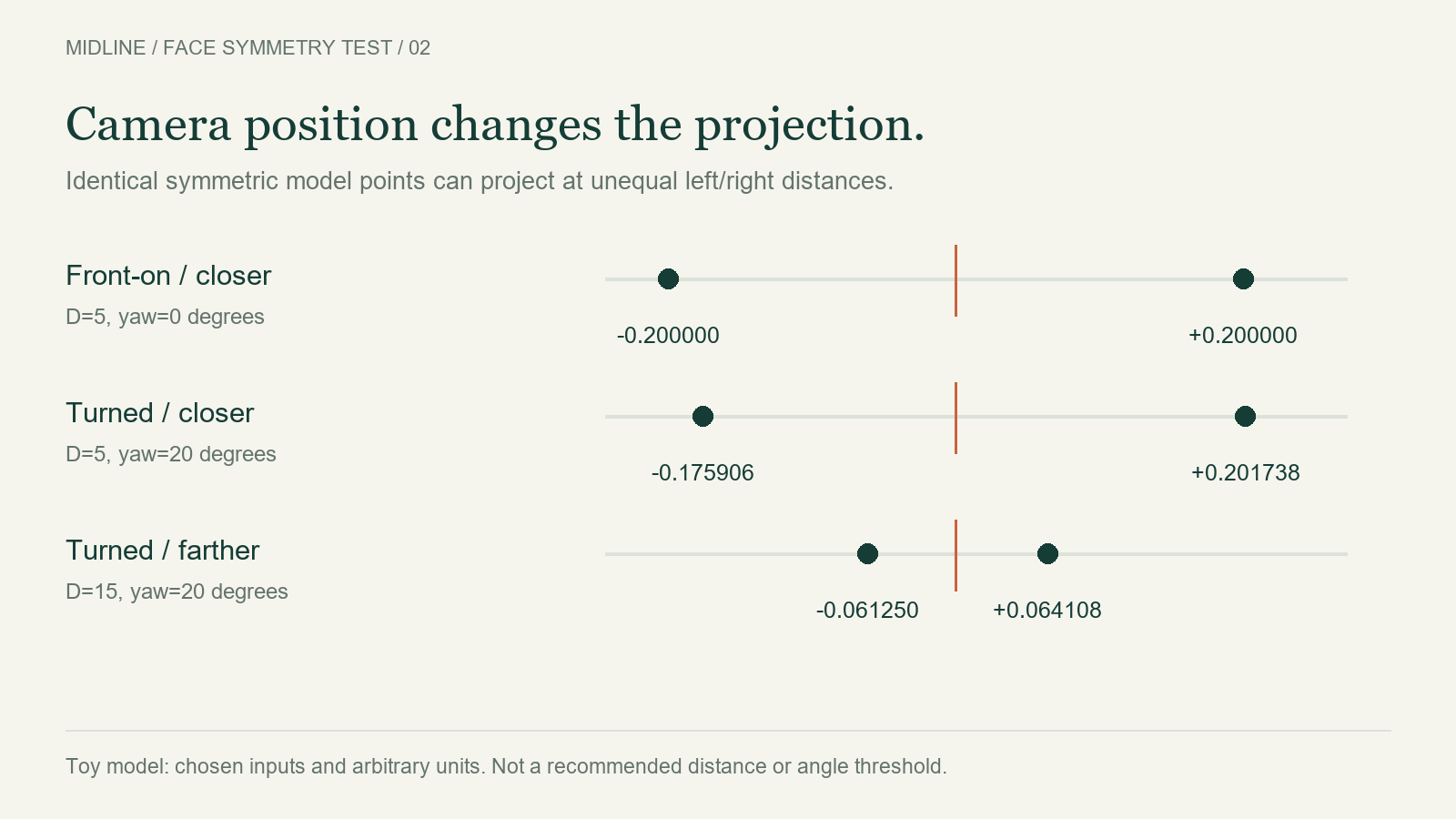
| Setup | D | θ | Left u | Right u |
|---|---|---|---|---|
| Front-on / closer | 5 | 0° | -0.200000 | +0.200000 |
| Turned / closer | 5 | 20° | -0.175906 | +0.201738 |
| Turned / farther | 15 | 20° | -0.061250 | +0.064108 |
This model is intentionally thin: it has no skin, lighting, lens correction or landmark detector. It demonstrates one projection mechanism, not the size of that effect in your phone. It also explains why digitally flipping an existing photo is not a substitute for taking a second photo from a different position.
Why can a symmetry score still change after a flip?
Geometry and detection are separate steps. Our existing controlled experiment uploaded one NASA portrait and its horizontally mirrored version three times each. All three original runs displayed 98.0 overall and 97.1 for the mouth; all three mirrored runs displayed 97.9 overall and 95.3 for the mouth. These are previously recorded browser observations, not new tests of a rear camera.
The flip did not change the photographed person. The different output shows that this detection-and-scoring pipeline did not return an invariant result for that file. It does not isolate the internal cause, establish typical error or prove that one orientation is the “real” score. See every input, repeat, feature score and limitation in the full experiment.
3. What to do before you compare photos or scores
Neither a front camera nor a rear camera is automatically the truth. Use a repeatable setup rather than picking whichever photo gives the score you want.
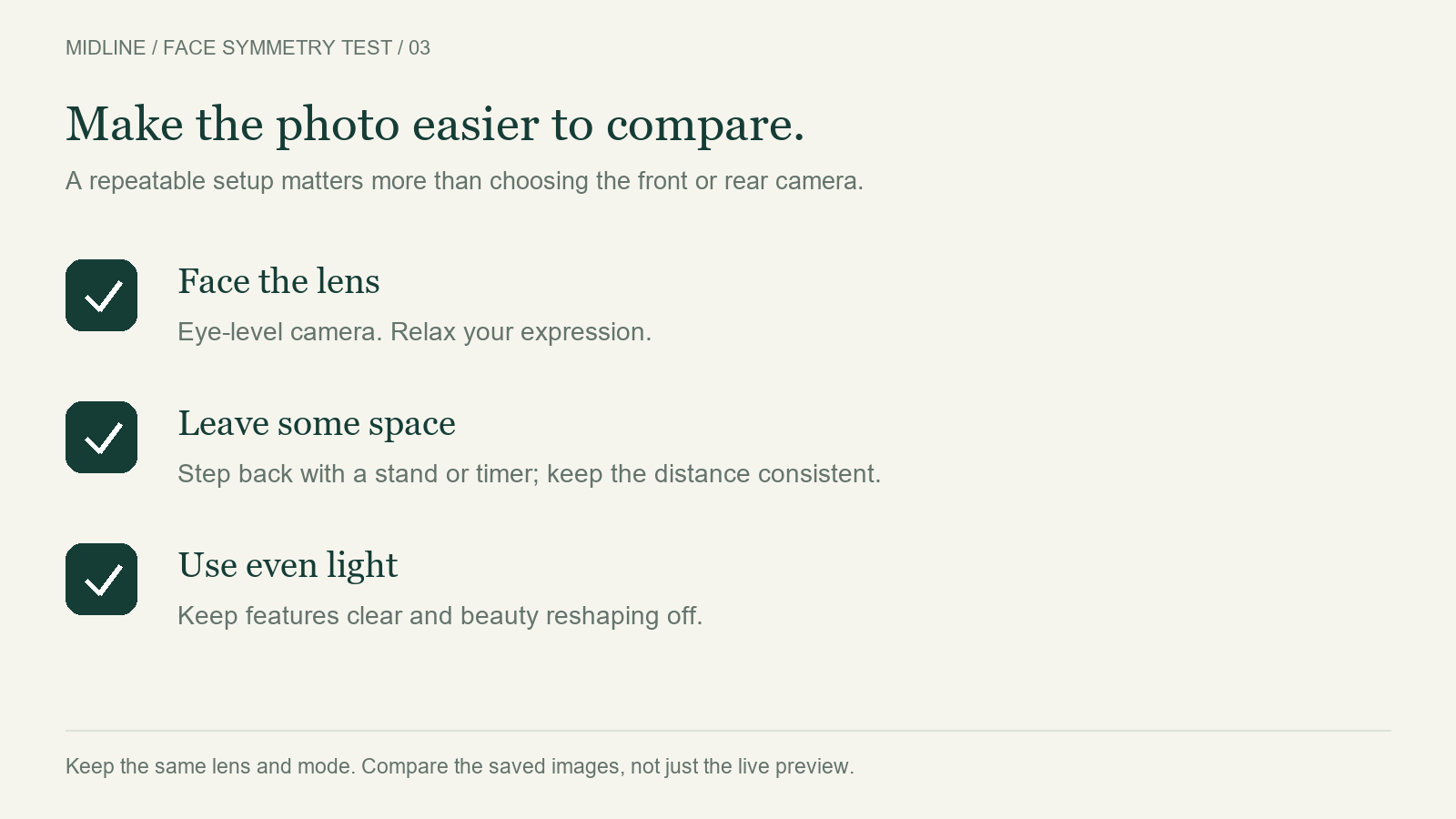
- Set the camera straight ahead. Keep it at eye level and look toward the lens. Avoid deliberately turning your head to make the sides look different.
- Give the camera some space. Use a stand or timer so you can step back and frame the face without holding the lens very close. Keep that distance the same for later comparisons. We have not tested a universal best distance for this tool.
- Keep the rest steady. Use even light, a relaxed expression and the same lens/mode. Turn off beauty reshaping when possible; keep hair away from the outline.
- Check the saved image. A preview can be mirrored differently from its saved photo. Use visible text or another asymmetric object to check orientation rather than guessing from the camera’s name.
- Read the overlay and features. A score needs correctly placed landmarks. Look at the eye, brow, nose, mouth and jaw results as well as the average. If landmarks miss the face, use a clearer input.
Then use our face symmetry test to compare the geometry of a consistent photo. The tool cannot tell you how much other people notice your face in everyday life, diagnose a cause, or recover a definitive “real face” from a single picture.
Quick answers
Does the back camera make my face more asymmetrical?
Not automatically. The captured proportions depend on position, angle and processing; an unfamiliar orientation can change what stands out to you. A photo alone cannot quantify how noticeable a difference is in person.
Is the mirror or camera what other people see?
A non-mirrored photo has the familiar left/right orientation that other people see, but its perspective, frozen expression and flat image are still only one view. Neither a mirror image nor a single photo reproduces the whole experience of seeing you in person.
Should I use the front or rear camera for the test?
Either can provide an input. Consistent distance, a straight-on view, visible features and unaltered image geometry matter more than the label “front” or “rear.” Do not compare two scores as if conditions were identical when the camera setup changed.
Does a higher score mean I look better?
No. This tool reports a product-defined geometric index for a photo. It does not measure attractiveness or personal value.
Sources and scope
- r/AskReddit comment, accessed 20 October 2026. Used only as a personal account; exact publication date and vote count were not verified.
- Mita, Dermer & Knight (1977), Reversed facial images and the mere-exposure hypothesis. Author-uploaded paper; a preference study, not a camera-accuracy or asymmetry-severity test.
- Ward et al. (2018), Nasal Distortion in Short-Distance Photographs: The Selfie Effect. Author-hosted paper; a model of projected facial proportions.
- Midline controlled-input experiment, 20 October 2026. One source portrait, nine conditions, three repeats each. The examples here reuse its original and mirrored runs.
No camera comparison with human participants was performed for this guide. The projection example is a labeled mathematical illustration. The Reddit discussion does not establish a general fact about what other people notice.