IMAGE SIZE / 22 OCTOBER 2026
Calculate face symmetry: does image size change the score?
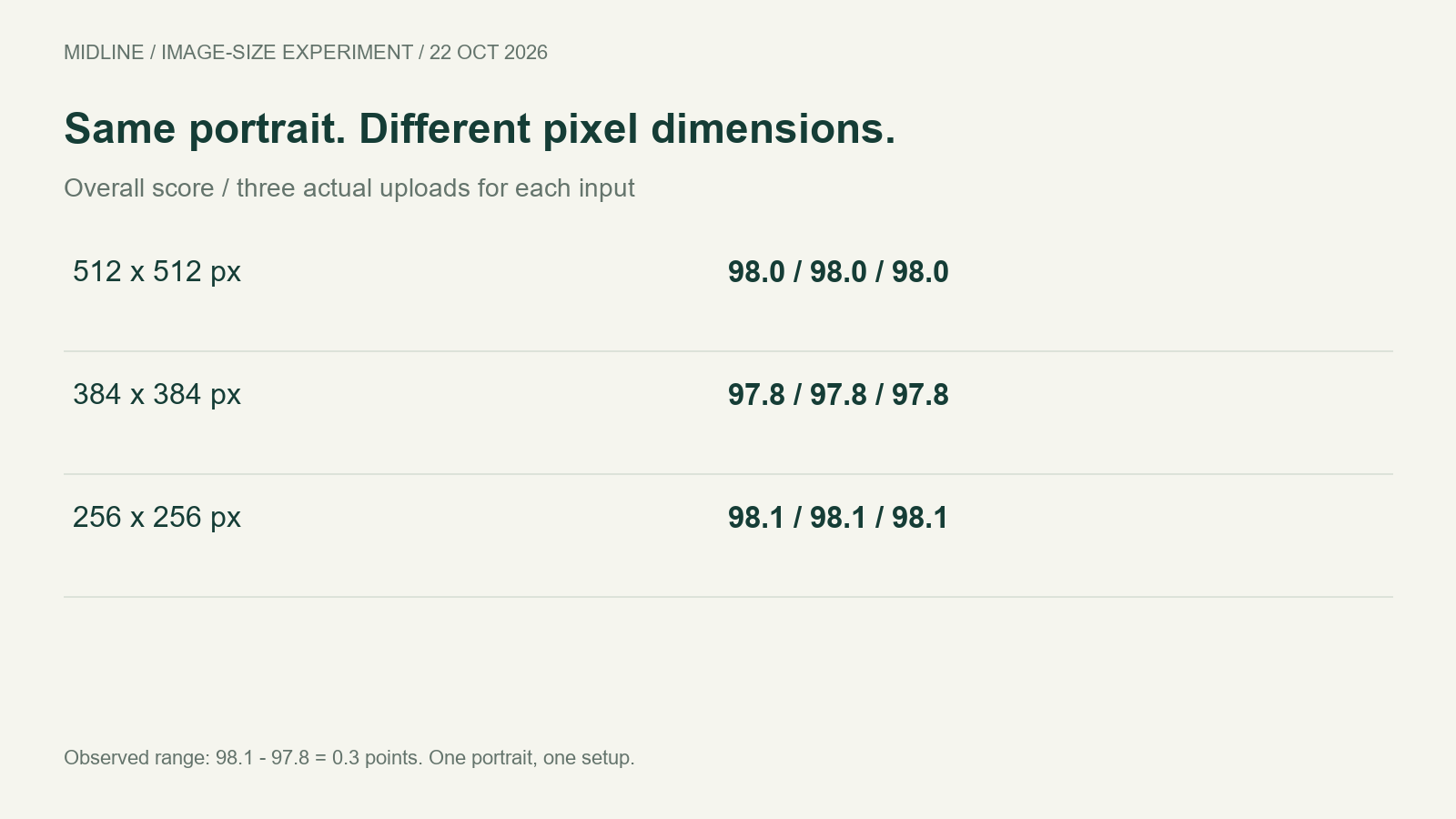
Yes, in this small test. The same portrait scored 98.0 at 512 × 512 pixels, 97.8 at 384 × 384, and 98.1 at 256 × 256. Each input was uploaded three times; its displayed scores matched across repeats. The largest overall difference was 0.3 points. A smaller image did not consistently mean a lower score.
The picture stayed the same; the pixels changed
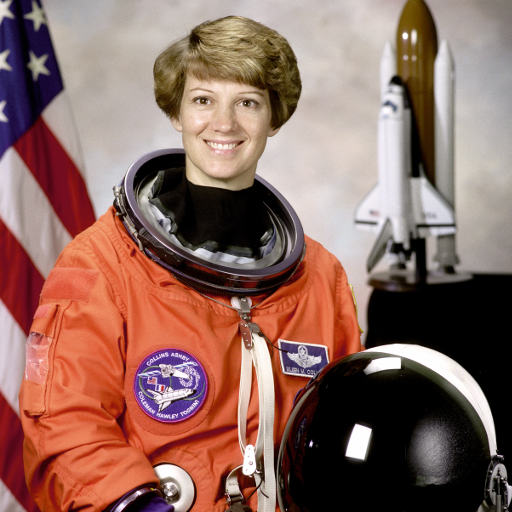
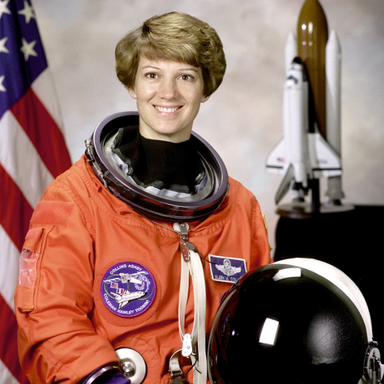
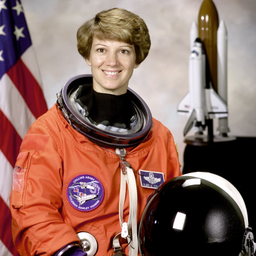
We resized one public astronaut portrait rather than taking new photographs. All inputs remained square, with the same framing and expression. We changed pixel dimensions using LANCZOS resampling and saved lossless PNG files. There was no deliberate rotation, crop, mirror flip or JPEG-compression change.
This asks a different question from changing camera position. It also differs from our page-reload check, which kept the file itself fixed. If you want to compare readings, the exact file is part of the measurement setup.
All nine runs, including every feature
| Input size | Repeat | Overall | Eyes | Eyebrows | Nose | Mouth | Jaw |
|---|---|---|---|---|---|---|---|
| 512 × 512 | 1 | 98.0 | 98.0 | 98.2 | 98.2 | 97.1 | 98.6 |
| 512 × 512 | 2 | 98.0 | 98.0 | 98.2 | 98.2 | 97.1 | 98.6 |
| 512 × 512 | 3 | 98.0 | 98.0 | 98.2 | 98.2 | 97.1 | 98.6 |
| 384 × 384 | 1 | 97.8 | 97.7 | 97.9 | 97.9 | 97.3 | 97.9 |
| 384 × 384 | 2 | 97.8 | 97.7 | 97.9 | 97.9 | 97.3 | 97.9 |
| 384 × 384 | 3 | 97.8 | 97.7 | 97.9 | 97.9 | 97.3 | 97.9 |
| 256 × 256 | 1 | 98.1 | 98.5 | 98.0 | 98.9 | 97.7 | 97.7 |
| 256 × 256 | 2 | 98.1 | 98.5 | 98.0 | 98.9 | 97.7 | 97.7 |
| 256 × 256 | 3 | 98.1 | 98.5 | 98.0 | 98.9 | 97.7 | 97.7 |
The overall range is max(98.0, 97.8, 98.1) − min(98.0, 97.8, 98.1) = 0.3 points, using the displayed values above. We did not calculate a confidence interval or an accuracy percentage. Three repeats of one input are not three people.
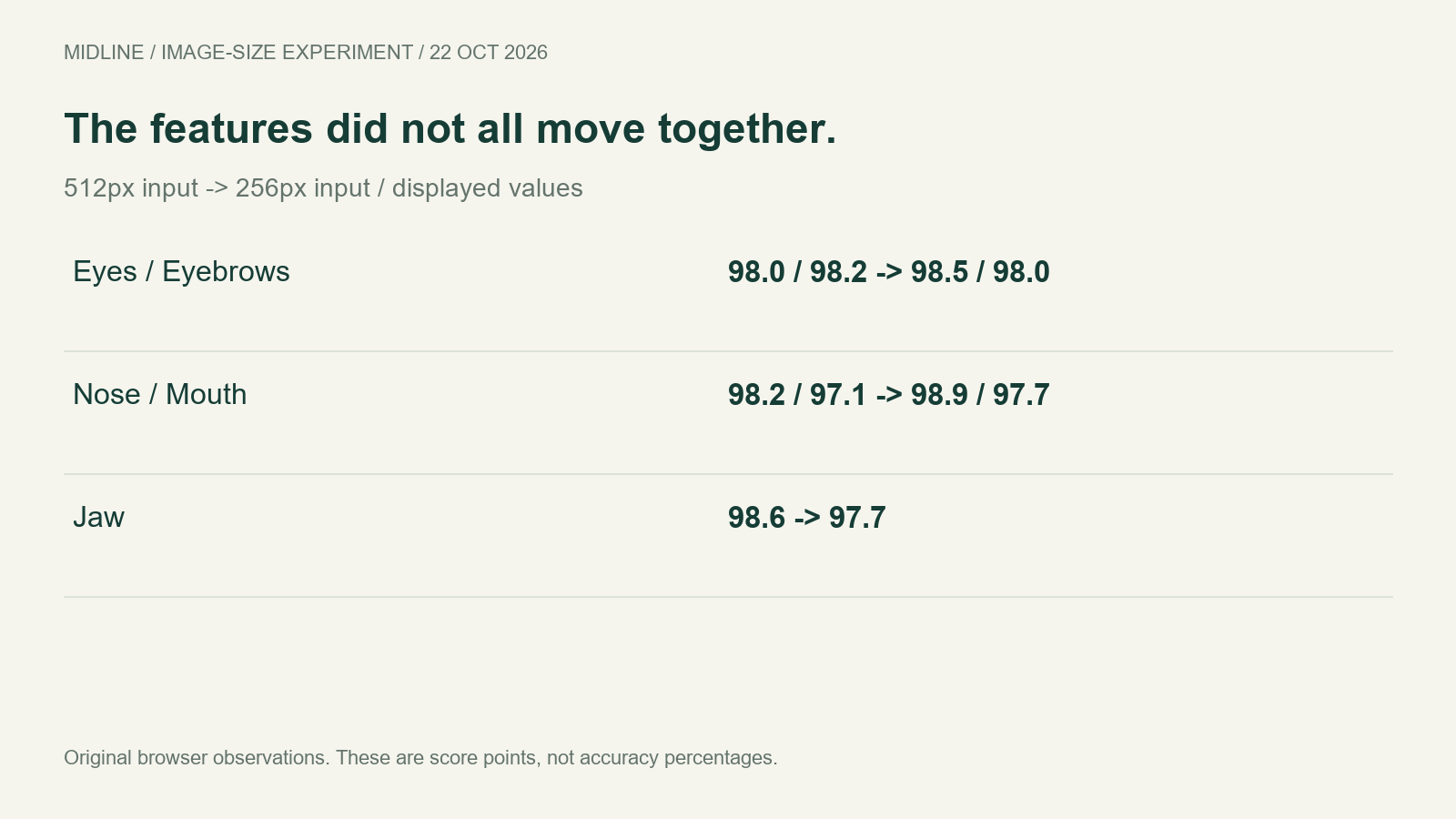
Between the 512-pixel and 256-pixel inputs, eyes changed by 98.5 − 98.0 = +0.5 points, while jaw changed by 97.7 − 98.6 = −0.9 points. An overall number alone would hide these different directions. Each size also produced matching individual feature values in its three runs, at the precision shown.
How we ran the comparison
We selected the prepared 512-pixel file three times, then the 384-pixel file three times, then the 256-pixel file three times in the same Chrome tab on Windows. After each upload, we waited for “Analysis complete” and recorded the total, eyes, eyebrows, nose, mouth and jaw. All nine attempts completed with scores.
The app and model stayed fixed. The current implementation runs MediaPipe Face Landmarker in IMAGE mode with the CPU delegate, fits a midline and compares paired landmarks. Its longest-edge cap is 1600 pixels; these three inputs are below that cap. The app and model hashes, timestamps and input hashes are in our complete observation record.
In the implementation, pair error is reflected-point distance divided by pair separation. Each feature is 100 × max(0, 1 − mean pair error), and the total averages the five features. In an ideal uniform scaling of unchanged landmark coordinates, both distances scale together and their ratio stays fixed.
But we supplied resized pixels to a detector; we did not simply scale an existing landmark list. Our observation is that the displayed outputs changed. A plausible interpretation is that resampling altered the detector's estimated geometry. We did not record all raw landmarks here, so this experiment does not isolate the internal cause.
Input provenance: the scikit-image astronaut portrait, derived from NASA imagery. Reproduction files: 512-pixel PNG, 384-pixel PNG, and 256-pixel PNG. No participant's private photographs were used.
What this means when you calculate face symmetry
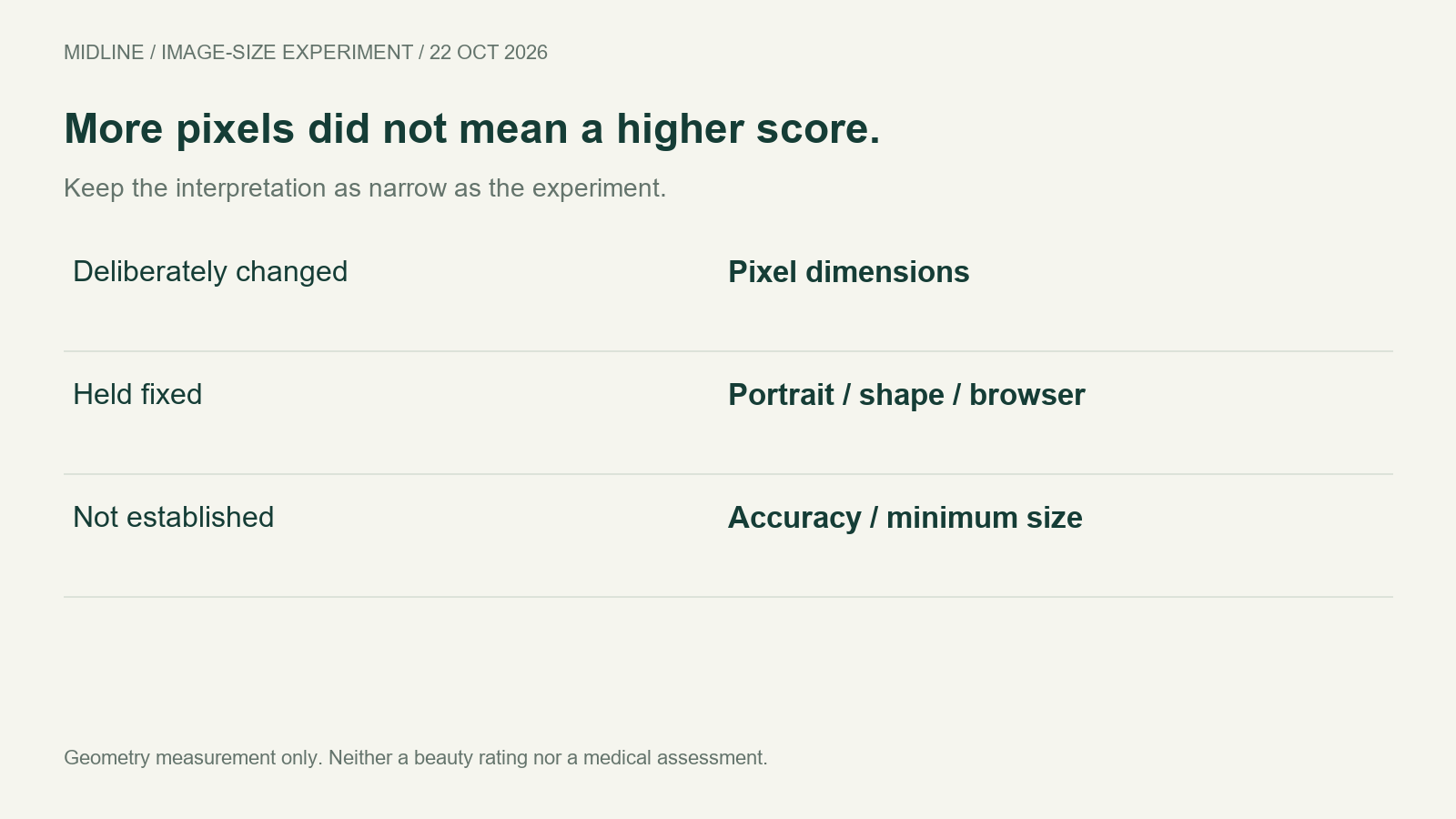
In these observations, the smallest tested input had the highest total, and the middle size had the lowest. That is a result about these files, not evidence that shrinking a photograph improves a measurement. We did not compare the scores with a reference annotation or a real-world symmetry measurement.
Keep the original file if you are comparing repeated readings. Avoid treating a score change after resizing as a physical change in your face. Review the landmark overlay, use a clear front-facing photo, and compare like with like. A number selected because it looks more flattering is not a validation result.
The study covers one portrait, one resampling method, one format and one browser/device setup. It does not establish a minimum image size, a normal score range, a beauty standard or a medical threshold. We did not test blur, screenshots, social-platform recompression or other faces in this protocol.
Quick answers
Will a larger file always score higher?
No such pattern appeared here: 512 pixels scored 98.0, 384 scored 97.8 and 256 scored 98.1. These are the nine-run table's observed values, not a general prediction.
Does a higher score mean the resized image is more accurate?
No. A symmetry score describes the geometry estimated from that image. Accuracy would require a suitable independent reference, which this experiment did not include.
Can I check this on my own device?
Use the three linked public files, upload each repeatedly, and note every feature as well as the total. Your setup may differ. The face symmetry test processes images in your browser and does not store a measurement history.
Watch the image-size experiment
English transcript
Evidence and scope
Our raw observation record supplies the inputs to every experimental number above. The site implementation supplies the calculation details. This is a geometric photo measurement, not a beauty rating or a medical assessment.
Try the photo-based tool ↗