REPEATABILITY / 21 OCTOBER 2026
Face symmetry tester: does reloading change the score?
In our check, it did not change the displayed scores. We uploaded the same public portrait three times after each of three page loads. All nine runs showed 98.0 overall, with matching feature values. This is a repeatability observation for one file in one Chrome browser, not proof that the scores are accurate.
The answer, at the precision you actually see
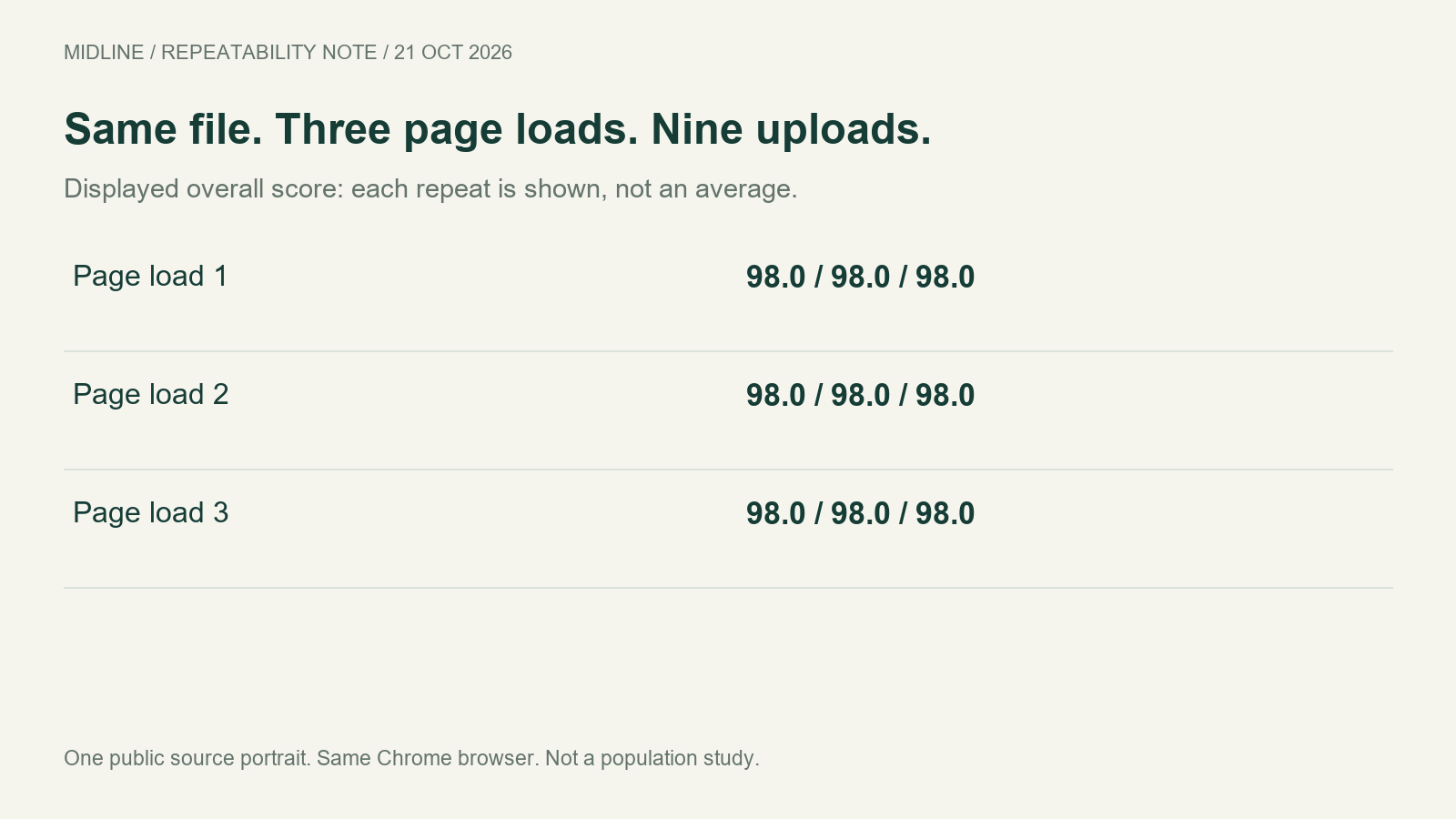
For this file, the observed range of the displayed overall values was max(98.0, …, 98.0) − min(98.0, …, 98.0) = 0.0 points across nine uploads. The inputs are the nine rows below. The screen rounds to one decimal, so this does not establish zero variation in underlying landmarks or unrounded calculations.
When you compare tools, first ask which claim is being tested. Repeating an output, agreeing with a reference measurement, and explaining what the number means are separate questions. A high repeatability result cannot answer the other two.
What we held fixed and what we changed
We used the same lossless PNG in every upload: 512 × 512 pixels, 443,039 bytes. It is the public astronaut portrait distributed by scikit-image, derived from NASA imagery. We reused yesterday’s baseline file rather than photographing anyone or uploading a private photo.
The first condition was the initial page load. The next two conditions were ordinary reloads of that tab. After each load, we selected the same file three times and waited for the analysis-complete message before reading the total and all five features. We did not restart Chrome, clear its cache, change devices or create independent browser profiles.
In the tested app, page initialization creates a worker; the worker initializes MediaPipe Face Landmarker with the CPU delegate and IMAGE mode. A reload restarts the page and its worker. That is the initialization boundary this protocol investigates. It does not test every possible runtime or model setting.
The input SHA-256 is 74d3ec6cca600b36965c09e909769cea633b52668a183f36ad32f45187784441. Download the observation record for timestamps, app/model hashes, input details and the protocol. The score table contains displayed values, not hidden detector outputs.
Every repeat, including the feature values
| Page load | Repeat | Overall | Eyes | Eyebrows | Nose | Mouth | Jaw |
|---|---|---|---|---|---|---|---|
| 1 | 1 | 98.0 | 98.0 | 98.2 | 98.2 | 97.1 | 98.6 |
| 1 | 2 | 98.0 | 98.0 | 98.2 | 98.2 | 97.1 | 98.6 |
| 1 | 3 | 98.0 | 98.0 | 98.2 | 98.2 | 97.1 | 98.6 |
| 2 | 1 | 98.0 | 98.0 | 98.2 | 98.2 | 97.1 | 98.6 |
| 2 | 2 | 98.0 | 98.0 | 98.2 | 98.2 | 97.1 | 98.6 |
| 2 | 3 | 98.0 | 98.0 | 98.2 | 98.2 | 97.1 | 98.6 |
| 3 | 1 | 98.0 | 98.0 | 98.2 | 98.2 | 97.1 | 98.6 |
| 3 | 2 | 98.0 | 98.0 | 98.2 | 98.2 | 97.1 | 98.6 |
| 3 | 3 | 98.0 | 98.0 | 98.2 | 98.2 | 97.1 | 98.6 |
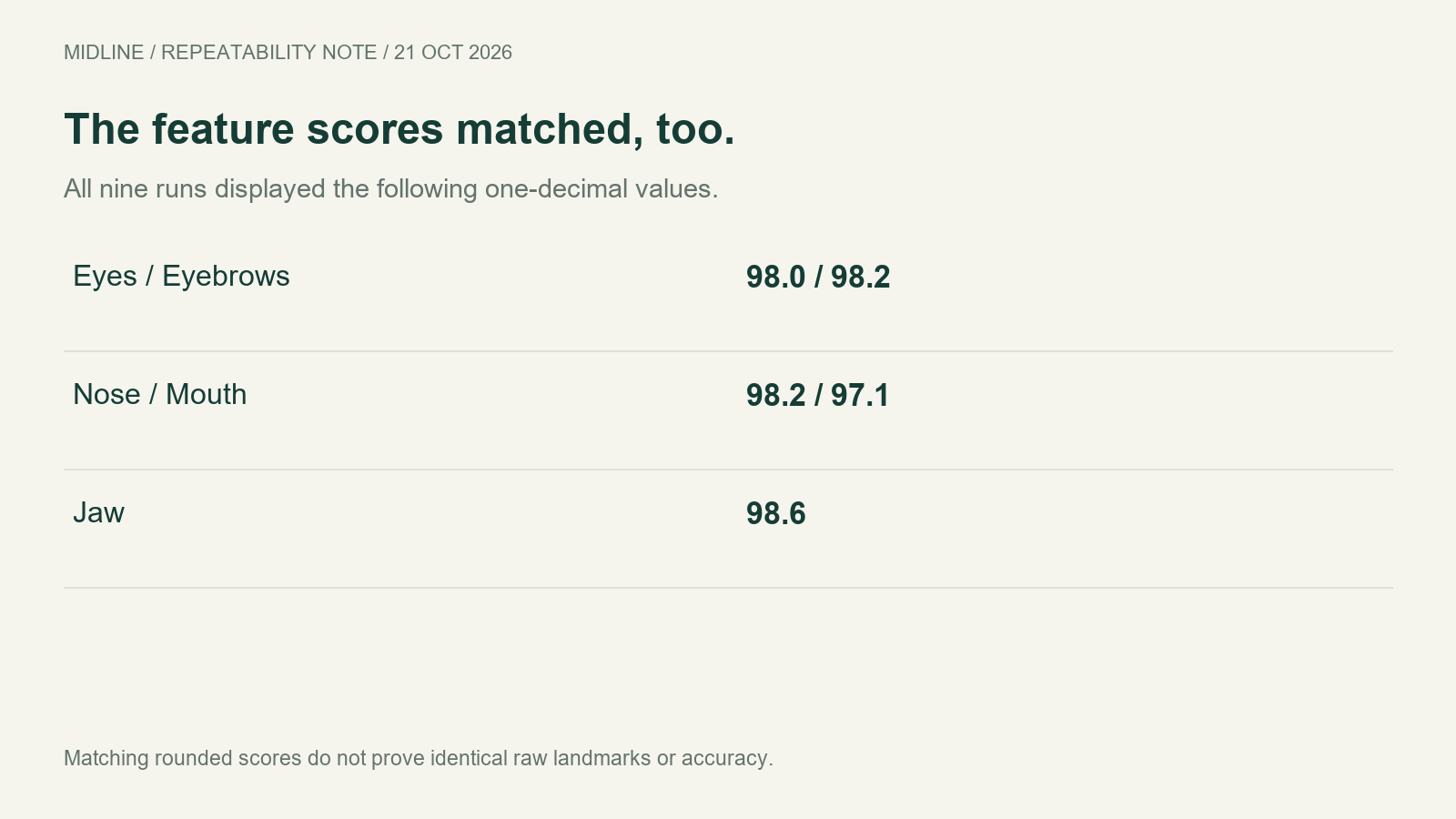
All nine rows also matched on each individual feature. This matters because an unchanged average alone could hide offsetting changes in different features. Here, no difference was visible at the displayed precision in any of the five fields.
What this does not establish
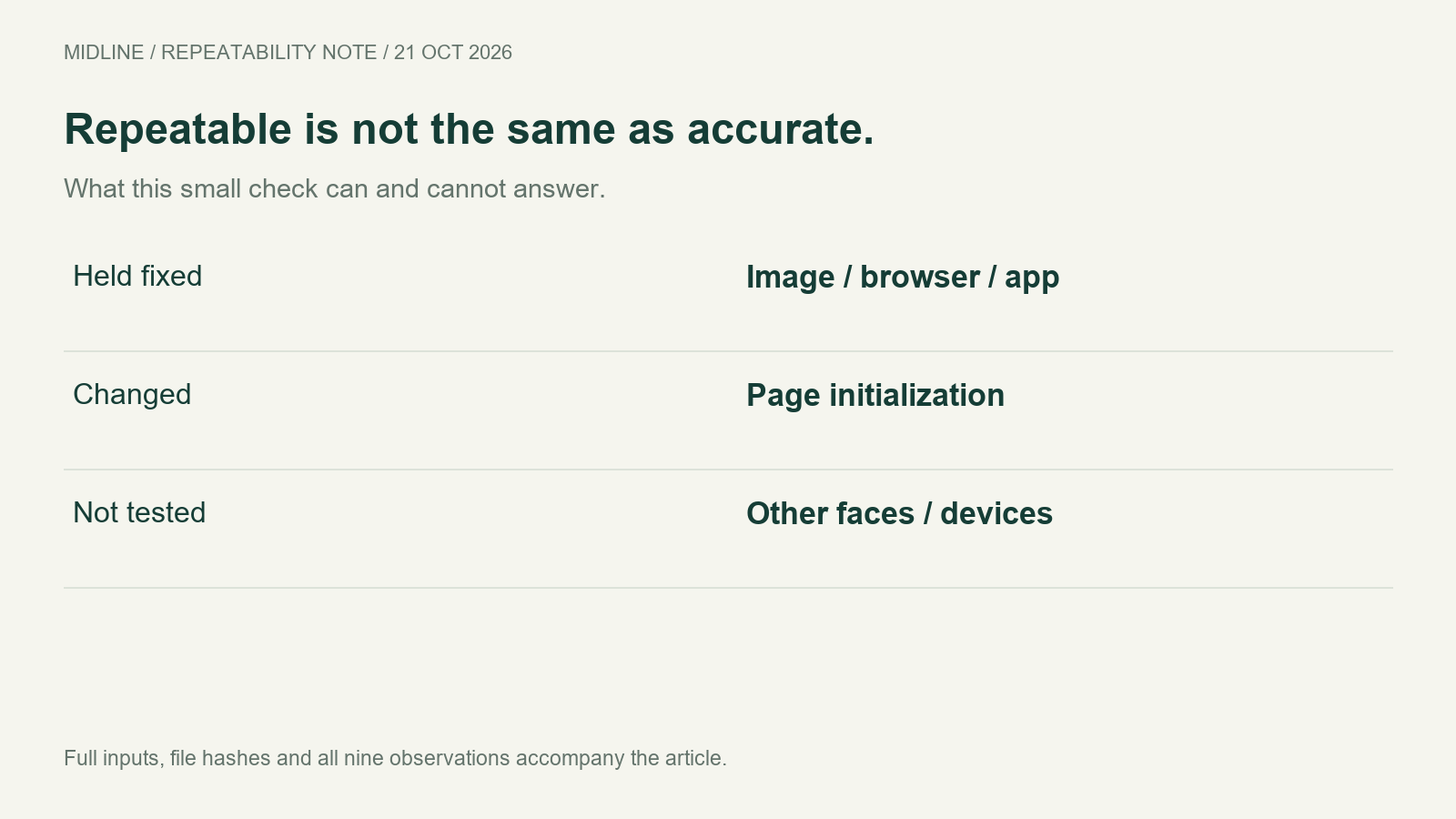
The sample is one portrait. The browser, file, app and device were held fixed. We did not compare against annotated ground-truth landmarks, take a live camera sequence, or test a different face. There is no measured accuracy rate, population norm, acceptable asymmetry threshold or confidence interval in this study.
The result also does not mean a new photo should match. Different head positions, crops and lighting can produce a different input to the detector. Our controlled image-change experiment asks that separate question; the camera and mirror guide explains why a photograph is only one view.
Quick answers
Should I reload until I get a better score?
Our nine runs did not produce a better displayed score after reloading. Repeatedly selecting the most flattering number is not a way to validate a measurement. Inspect the landmark overlay and keep input conditions consistent.
Did you prove the detector is deterministic?
No. We observed matching rounded outputs for this protocol. We did not compare every raw landmark or prove a guarantee across executions, machines, versions or files.
Can I try the same procedure?
Yes. Open the photo-based test, choose one image, note all feature values, repeat twice, then reload and repeat. Keep a local note of the file and conditions. The tool does not store a history. Treat your results as observations about your own setup.
Watch the repeatability walkthrough
English transcript
Sources and audit
Evidence: our complete observations; input provenance: scikit-image astronaut documentation; implementation: this site’s app.js. The browser measurements were taken on 21 October 2026; no competitor experiment or Reddit claim is presented as our result.
Try a consistent photo ↗