NOSE FIELD / 31 OCTOBER 2026
Nose asymmetry in photos: why the nose score can fall when the total rises
A nose that looks uneven in a photo cannot be explained by a symmetry score alone. In our saved file test, rotating one portrait raised the total from 98.0 to 98.1 while the nose field fell from 98.2 to 97.8. That is an image-output comparison, not evidence that the person’s nose changed. Read the nose field and overlay together; these records cannot identify a physical cause.
Watch the nose-field comparison
English transcript
A higher overall photo score does not mean a higher nose score. In our saved rotation test, the total rose while the nose field fell. These readings describe an image, not a physical change in the person. The original portrait returned a nose reading of 98.2. Darkening returned 98.1, flat rotation 97.8, resizing 98.9, and JPEG encoding 97.1. Every prepared file was uploaded three times on October twenty sixth. All three displayed readings matched within each condition. Look at the rotated copy. The total changed from 98.0 to 98.1, but the nose field changed from 98.2 to 97.8. That is plus 0.1 overall and minus 0.4 for the nose. A single total hides this difference. No raw landmark coordinates were saved, so we cannot identify the internal estimate that changed. In the separate camera case, the frontal nose readings were 98.6 and 96.6, each repeated three times. Distance alone was not isolated. Both turned pictures were refused on all three attempts. Those six attempts have no nose score. Ten unchanged-file uploads in the other dataset repeated 98.2, with a displayed range of 0.0. Inspect the nose overlay and keep the original file, date, all fields, repeats and refusals. Read the complete records on our nose asymmetry page. Photo geometry only, not a beauty rating or medical assessment.
Start with the nose in the image
Use the original photograph when inspecting the nose markers. A total combines feature outputs; it is not a left-or-right label for the nose. We did not record raw landmark coordinates or a physical reference length in these runs, so we cannot report which side moved, a tip displacement or a millimetre gap.
The records below separate a new camera capture from processing an existing file. They do not establish an ideal angle, a normal score or an explanation of anatomy. This is photo geometry, not a beauty rating or a medical assessment.
The same portrait, five prepared files
Recorded on 26 October 2026: one public portrait supplied the original PNG and four prepared copies, with three uploads per file. All 15 uploads are retained below with their total and five feature fields. No new experiment was run for this article.
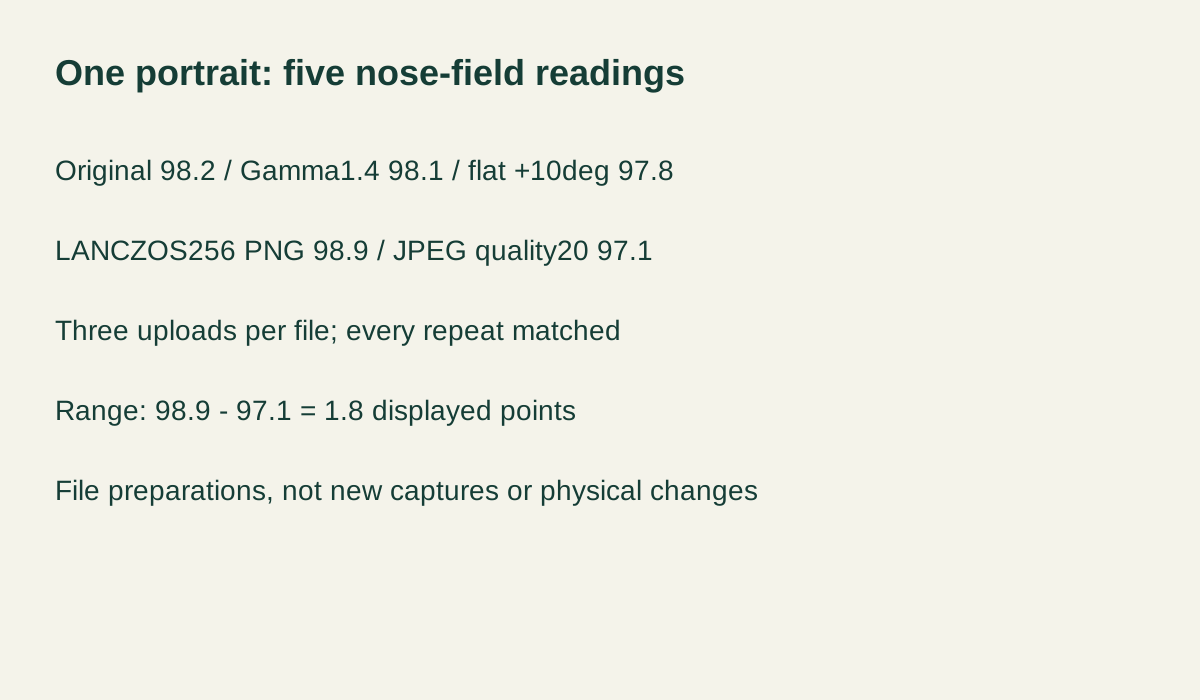
The nose field was 98.2, 98.2 and 98.2 for the original. Gamma1.4 darkening returned 98.1 on each upload. Flat +10° rotation returned 97.8 each time. The 256×256 LANCZOS PNG returned 98.9 each time, and JPEG quality20 with subsampling2 returned 97.1 each time.
Differences from the original nose reading were 98.1−98.2=−0.1, 97.8−98.2=−0.4, 98.9−98.2=+0.7 and 97.1−98.2=−1.1 points. The five-file range was 98.9−97.1=1.8 points. These are displayed score points, not physical units.
Gamma is a pixel-tone change, not moving a lamp. Rotating a flat image is not turning a head. Resampling the file does not change camera distance. These distinctions prevent a file-processing observation from becoming a claim about a person.
A higher total can conceal a lower nose field
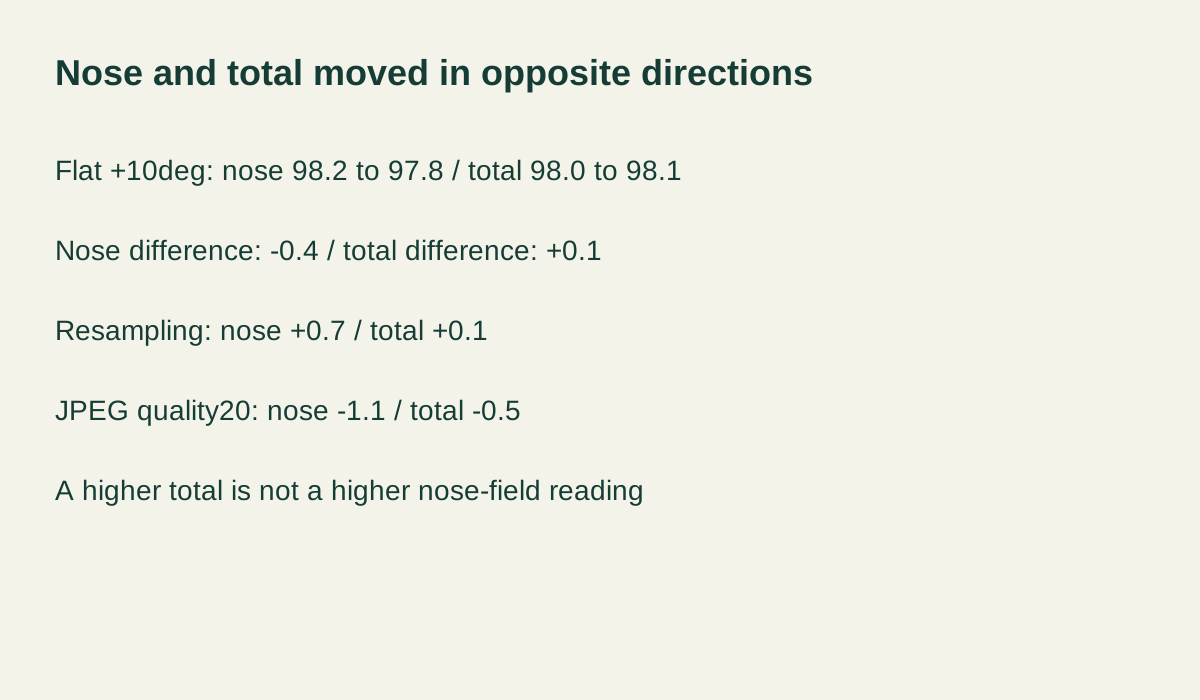
The original overall was 98.0. Flat rotation returned 98.1 overall and 97.8 for the nose: total +0.1, nose −0.4. Choosing the higher total would conceal that lower nose reading. In the other preparations, gamma returned 97.6 overall, resampling 98.1 and JPEG 97.5; each was repeated three times.
The resampled copy raised the nose field by 0.7 and the total by 0.1. JPEG lowered the nose field by 1.1 and the total by 0.5. We cannot identify the internal landmark estimate responsible because raw coordinates were not saved.
What the camera and repeat records add
The separate camera case was recorded on 21 October 2026 with one consenting participant. Near/front returned nose98.6 on all three attempts; far/front returned nose96.6 on all three. Their nose difference was 98.6−96.6=2.0 points. The owner reported about 30–40cm and 0.8m, but lens, zoom and camera height were not recorded. Distance alone was not isolated.
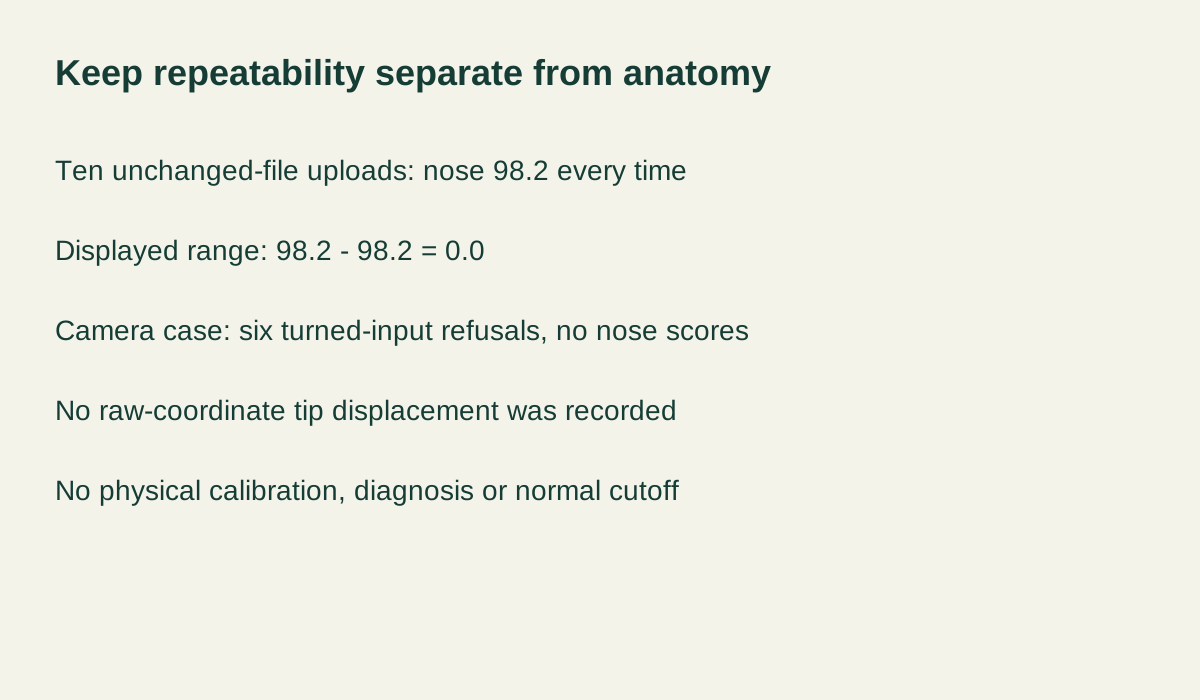
Both turned captures were refused three times each. All six attempts had no total and no nose or other feature scores. The exact message was “Your head appears turned. Use a photo facing straight toward the camera.” No score must remain distinct from a low score.
On 26 October, ten uploads of the unchanged public-portrait file each returned nose98.2. The observed displayed range was 98.2−98.2=0.0. This is a ten-upload check of one file, not zero underlying noise or calibrated accuracy. The camera participant and public portrait are separate inputs, not a combined sample of people.
Inspect the score with its input record
Open the face symmetry test, select the original file and check where the nose markers land. Save its nose field alongside the total. For an exact-file comparison, change only the chosen file preparation and keep every attempt. For a new photograph, record camera position and distance separately rather than calling it the same input.
Our photo variables guide brings the broader comparisons together. The camera case contains the original capture conditions, and the file audit retains the original field-by-field comparisons.
Three questions about a nose asymmetry score
Does a higher total mean the nose field rose?
No. In the saved rotated file, the total increased by 0.1 while the nose field decreased by 0.4. Read both outputs.
Does 98.2 identify which side of the nose is different?
No. That saved output is an index, not a signed left-minus-right measurement or a calibrated distance.
Can a turned-photo refusal tell me my nose score?
No. Our six turned-input refusals returned no feature values. We do not fill those cells with estimated scores.
The complete dated record
All 37 original attempts remain available here: 12 camera attempts including six refusals, 15 prepared-file uploads and ten unchanged-file repeats. Dates are the measurement dates, not this article’s publication date. No failed attempt was removed.
Show all original totals, five fields, repeats and refusal messages
| Date | Input / conditions | Repeat | Overall | Eyes | Eyebrows | Nose | Mouth | Jaw | Recorded status |
|---|---|---|---|---|---|---|---|---|---|
| 2026-10-21 | 150 Far / turned; About 0.8 m / about 15–20° | 1 | — | — | — | — | — | — | Your head appears turned. Use a photo facing straight toward the camera. |
| 2026-10-21 | 150 Far / turned; About 0.8 m / about 15–20° | 2 | — | — | — | — | — | — | Your head appears turned. Use a photo facing straight toward the camera. |
| 2026-10-21 | 150 Far / turned; About 0.8 m / about 15–20° | 3 | — | — | — | — | — | — | Your head appears turned. Use a photo facing straight toward the camera. |
| 2026-10-21 | 151 Far / front; About 0.8 m / front-on | 1 | 96.1 | 95.5 | 97.5 | 96.6 | 98.1 | 92.5 | Analysis complete. Try another photo under the same conditions. |
| 2026-10-21 | 151 Far / front; About 0.8 m / front-on | 2 | 96.1 | 95.5 | 97.5 | 96.6 | 98.1 | 92.5 | Analysis complete. Try another photo under the same conditions. |
| 2026-10-21 | 151 Far / front; About 0.8 m / front-on | 3 | 96.1 | 95.5 | 97.5 | 96.6 | 98.1 | 92.5 | Analysis complete. Try another photo under the same conditions. |
| 2026-10-21 | 152 Near / turned; About 30–40 cm / about 15–20° | 1 | — | — | — | — | — | — | Your head appears turned. Use a photo facing straight toward the camera. |
| 2026-10-21 | 152 Near / turned; About 30–40 cm / about 15–20° | 2 | — | — | — | — | — | — | Your head appears turned. Use a photo facing straight toward the camera. |
| 2026-10-21 | 152 Near / turned; About 30–40 cm / about 15–20° | 3 | — | — | — | — | — | — | Your head appears turned. Use a photo facing straight toward the camera. |
| 2026-10-21 | 153 Near / front; About 30–40 cm / front-on | 1 | 98.6 | 99.0 | 98.5 | 98.6 | 98.0 | 99.1 | Analysis complete. Try another photo under the same conditions. |
| 2026-10-21 | 153 Near / front; About 30–40 cm / front-on | 2 | 98.6 | 99.0 | 98.5 | 98.6 | 98.0 | 99.1 | Analysis complete. Try another photo under the same conditions. |
| 2026-10-21 | 153 Near / front; About 30–40 cm / front-on | 3 | 98.6 | 99.0 | 98.5 | 98.6 | 98.0 | 99.1 | Analysis complete. Try another photo under the same conditions. |
| Date | Input / conditions | Repeat | Overall | Eyes | Eyebrows | Nose | Mouth | Jaw | Recorded status |
|---|---|---|---|---|---|---|---|---|---|
| 2026-10-26 | Unchanged PNG512 | 1 | 98.0 | 98.0 | 98.2 | 98.2 | 97.1 | 98.6 | Analysis complete. Try another photo under the same conditions. |
| 2026-10-26 | Unchanged PNG512 | 2 | 98.0 | 98.0 | 98.2 | 98.2 | 97.1 | 98.6 | Analysis complete. Try another photo under the same conditions. |
| 2026-10-26 | Unchanged PNG512 | 3 | 98.0 | 98.0 | 98.2 | 98.2 | 97.1 | 98.6 | Analysis complete. Try another photo under the same conditions. |
| 2026-10-26 | Gamma1.4 darkening | 1 | 97.6 | 98.1 | 97.8 | 98.1 | 96.2 | 98.1 | Analysis complete. Try another photo under the same conditions. |
| 2026-10-26 | Gamma1.4 darkening | 2 | 97.6 | 98.1 | 97.8 | 98.1 | 96.2 | 98.1 | Analysis complete. Try another photo under the same conditions. |
| 2026-10-26 | Gamma1.4 darkening | 3 | 97.6 | 98.1 | 97.8 | 98.1 | 96.2 | 98.1 | Analysis complete. Try another photo under the same conditions. |
| 2026-10-26 | +10° flat rotation | 1 | 98.1 | 99.1 | 98.9 | 97.8 | 96.2 | 98.4 | Analysis complete. Try another photo under the same conditions. |
| 2026-10-26 | +10° flat rotation | 2 | 98.1 | 99.1 | 98.9 | 97.8 | 96.2 | 98.4 | Analysis complete. Try another photo under the same conditions. |
| 2026-10-26 | +10° flat rotation | 3 | 98.1 | 99.1 | 98.9 | 97.8 | 96.2 | 98.4 | Analysis complete. Try another photo under the same conditions. |
| 2026-10-26 | LANCZOS256 px PNG | 1 | 98.1 | 98.5 | 98.0 | 98.9 | 97.7 | 97.7 | Analysis complete. Try another photo under the same conditions. |
| 2026-10-26 | LANCZOS256 px PNG | 2 | 98.1 | 98.5 | 98.0 | 98.9 | 97.7 | 97.7 | Analysis complete. Try another photo under the same conditions. |
| 2026-10-26 | LANCZOS256 px PNG | 3 | 98.1 | 98.5 | 98.0 | 98.9 | 97.7 | 97.7 | Analysis complete. Try another photo under the same conditions. |
| 2026-10-26 | JPEG quality20 subsampling2 | 1 | 97.5 | 98.6 | 98.7 | 97.1 | 96.4 | 96.9 | Analysis complete. Try another photo under the same conditions. |
| 2026-10-26 | JPEG quality20 subsampling2 | 2 | 97.5 | 98.6 | 98.7 | 97.1 | 96.4 | 96.9 | Analysis complete. Try another photo under the same conditions. |
| 2026-10-26 | JPEG quality20 subsampling2 | 3 | 97.5 | 98.6 | 98.7 | 97.1 | 96.4 | 96.9 | Analysis complete. Try another photo under the same conditions. |
| Date | Input / conditions | Repeat | Overall | Eyes | Eyebrows | Nose | Mouth | Jaw | Recorded status |
|---|---|---|---|---|---|---|---|---|---|
| 2026-10-26 | Exact unchanged baseline file | 1 | 98.0 | 98.0 | 98.2 | 98.2 | 97.1 | 98.6 | Analysis complete. Try another photo under the same conditions. |
| 2026-10-26 | Exact unchanged baseline file | 2 | 98.0 | 98.0 | 98.2 | 98.2 | 97.1 | 98.6 | Analysis complete. Try another photo under the same conditions. |
| 2026-10-26 | Exact unchanged baseline file | 3 | 98.0 | 98.0 | 98.2 | 98.2 | 97.1 | 98.6 | Analysis complete. Try another photo under the same conditions. |
| 2026-10-26 | Exact unchanged baseline file | 4 | 98.0 | 98.0 | 98.2 | 98.2 | 97.1 | 98.6 | Analysis complete. Try another photo under the same conditions. |
| 2026-10-26 | Exact unchanged baseline file | 5 | 98.0 | 98.0 | 98.2 | 98.2 | 97.1 | 98.6 | Analysis complete. Try another photo under the same conditions. |
| 2026-10-26 | Exact unchanged baseline file | 6 | 98.0 | 98.0 | 98.2 | 98.2 | 97.1 | 98.6 | Analysis complete. Try another photo under the same conditions. |
| 2026-10-26 | Exact unchanged baseline file | 7 | 98.0 | 98.0 | 98.2 | 98.2 | 97.1 | 98.6 | Analysis complete. Try another photo under the same conditions. |
| 2026-10-26 | Exact unchanged baseline file | 8 | 98.0 | 98.0 | 98.2 | 98.2 | 97.1 | 98.6 | Analysis complete. Try another photo under the same conditions. |
| 2026-10-26 | Exact unchanged baseline file | 9 | 98.0 | 98.0 | 98.2 | 98.2 | 97.1 | 98.6 | Analysis complete. Try another photo under the same conditions. |
| 2026-10-26 | Exact unchanged baseline file | 10 | 98.0 | 98.0 | 98.2 | 98.2 | 97.1 | 98.6 | Analysis complete. Try another photo under the same conditions. |
Read the original combined reference copy; the two source datasets remain separate.