CAPTURE CONDITIONS / 21 OCTOBER 2026
Face symmetry analyzer: why angle and distance change a photo
Changing camera position can change the view of the same face without changing its underlying anatomy. In our four-photo case, the near front-on image scored 98.6 and the farther front-on image scored 96.1 in every repeat. Both turned-head images were rejected. These are photo-based observations, not proof that distance alone caused the difference.
One consenting participant. Four original photographs. Three analysis attempts per photograph. Geometric symmetry only—not a beauty rating or medical assessment.
Watch the angle and distance experiment
English explainer. Watch on YouTube.
1. The worry behind the camera question
In a QOVESStudio post dated 19 July 2026 (UTC), a writer described an unfamiliar view as something that “can be jarring which could lead to self-doubt about our own attractiveness.” The author explicitly excluded lighting and focal length and asked about mirrored orientation. That is useful context for the worry, not evidence about camera distance. We covered mirror reversal in the earlier photo guide; this page focuses on new captures.
A Mewing post dated 29 June 2026 (UTC) describes the trigger this way: “So i started noticing i have asymmetrical face when i look at the photos clicked on back camera”. We use that sentence as a personal account. The post’s exercise and correction claims are not established by our test, and we do not recommend or reproduce them.
Both original posts and their official metadata were checked 21 October 2026. Dates above are UTC; the QOVESStudio post falls on 20 July in Shanghai. Reddit reports 5 and 34 comments respectively at that check; these are changing platform counts, not study sample sizes.
2. Four real captures, twelve recorded attempts
The owner supplied the photographs and confirmed this mapping: 153 near/front, 151 far/front, 152 near/turned, 150 far/turned. Near distance was reported as approximately 30–40cm; far distance as approximately 0.8m; the slight turn as approximately 15–20°. These are owner estimates, not measurements recovered from the pictures. The owner reports the same day, lighting and phone and confirms permission for this public article.
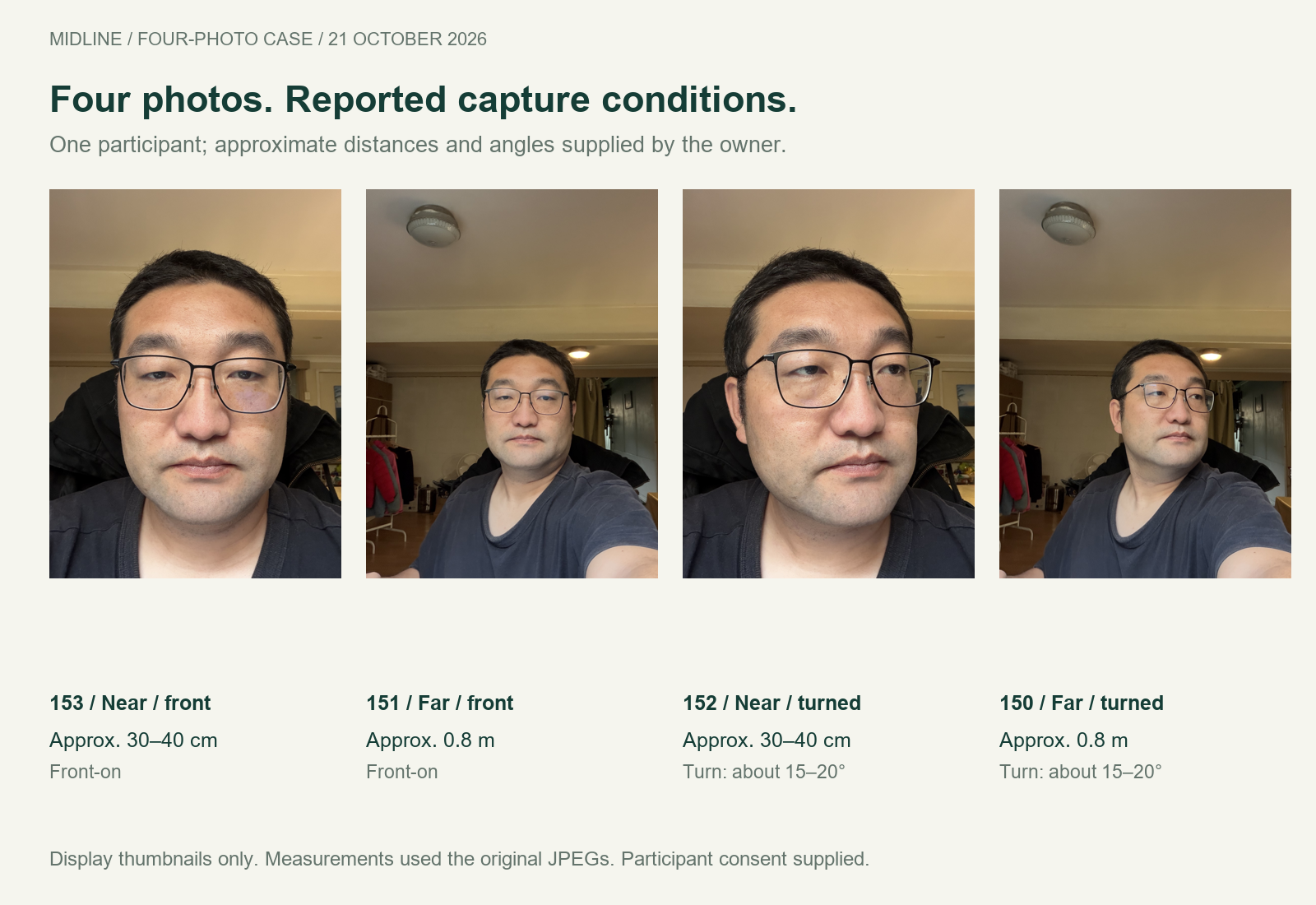
We selected each original JPEG in the live tool three times in Chrome and waited for completion or a refusal. We did not crop, rotate or resample files before selection, alter the scoring code, or bypass its head-turn check. The browser’s normal input pipeline resizes images whose longest side exceeds 1600 pixels; that same pipeline was used for every attempt.
There are four captures of one person, not twelve independent photographs or twelve people. The twelve rows are repeated analysis attempts. Each file’s dimensions, SHA-256, timestamped readings, app/model hashes and exact refusal text are in the complete observation record. The approximate capture conditions are kept separate from those measured file and browser facts.
| Photo / condition | Repeat | Overall | Eyes | Eyebrows | Nose | Mouth | Jaw | Status |
|---|---|---|---|---|---|---|---|---|
| 153 / Near / front | 1 | 98.6 | 99.0 | 98.5 | 98.6 | 98.0 | 99.1 | Completed |
| 153 / Near / front | 2 | 98.6 | 99.0 | 98.5 | 98.6 | 98.0 | 99.1 | Completed |
| 153 / Near / front | 3 | 98.6 | 99.0 | 98.5 | 98.6 | 98.0 | 99.1 | Completed |
| 151 / Far / front | 1 | 96.1 | 95.5 | 97.5 | 96.6 | 98.1 | 92.5 | Completed |
| 151 / Far / front | 2 | 96.1 | 95.5 | 97.5 | 96.6 | 98.1 | 92.5 | Completed |
| 151 / Far / front | 3 | 96.1 | 95.5 | 97.5 | 96.6 | 98.1 | 92.5 | Completed |
| 152 / Near / turned | 1 | — | — | — | — | — | — | Head-turn rejection |
| 152 / Near / turned | 2 | — | — | — | — | — | — | Head-turn rejection |
| 152 / Near / turned | 3 | — | — | — | — | — | — | Head-turn rejection |
| 150 / Far / turned | 1 | — | — | — | — | — | — | Head-turn rejection |
| 150 / Far / turned | 2 | — | — | — | — | — | — | Head-turn rejection |
| 150 / Far / turned | 3 | — | — | — | — | — | — | Head-turn rejection |
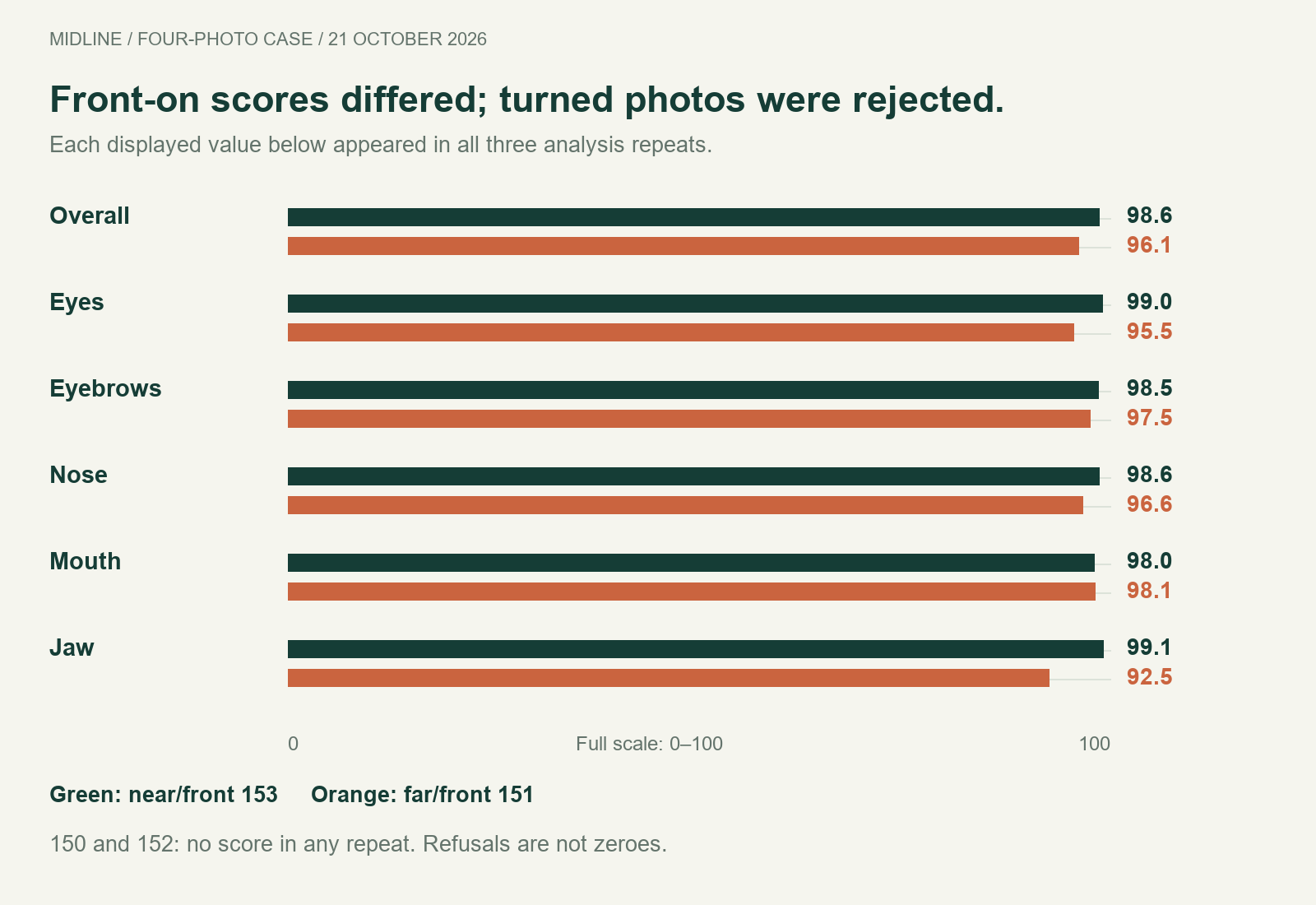
The overall average hid a larger jaw difference
Using far minus near for the two front-on images, the displayed overall difference is 96.1−98.6=−2.5 points. The feature differences are eyes 95.5−99.0=−3.5, eyebrows 97.5−98.5=−1.0, nose 96.6−98.6=−2.0, mouth 98.1−98.0=+0.1, and jaw 92.5−99.1=−6.6 points. These are subtractions of the displayed table values, not percentages or estimates of anatomical change.
The farther photo scored lower in this pair. This does not support a rule that moving farther away always produces a higher score. The jaw field shifted more than the total, while the mouth field moved slightly in the opposite direction. Inspecting only the average would miss that pattern.
Turning the head produced a refusal, not a low score
Files 150 and 152 returned the same message in all three attempts each: “Your head appears turned. Use a photo facing straight toward the camera.” Overall and all five feature fields stayed blank. There is therefore no measured front-versus-turn score difference to calculate from this set.
This refusal comes from the tested implementation’s pose screen. It does not verify the photographer’s estimated angle, establish a universal 15° or 20° limit, or imply that an unscored face is unusually asymmetrical. We retained the failures rather than changing the tool to force a number.
Why a new camera position can produce a different input
In a perspective projection, points at different distances from a lens appear at different scales. Moving the camera or turning a head changes which features are closer to the lens. A face symmetry analyzer then detects landmarks in that projected image; it does not recover a definitive three-dimensional face from one photograph. Our earlier guide’s camera explanation separates these image effects from mirror reversal.
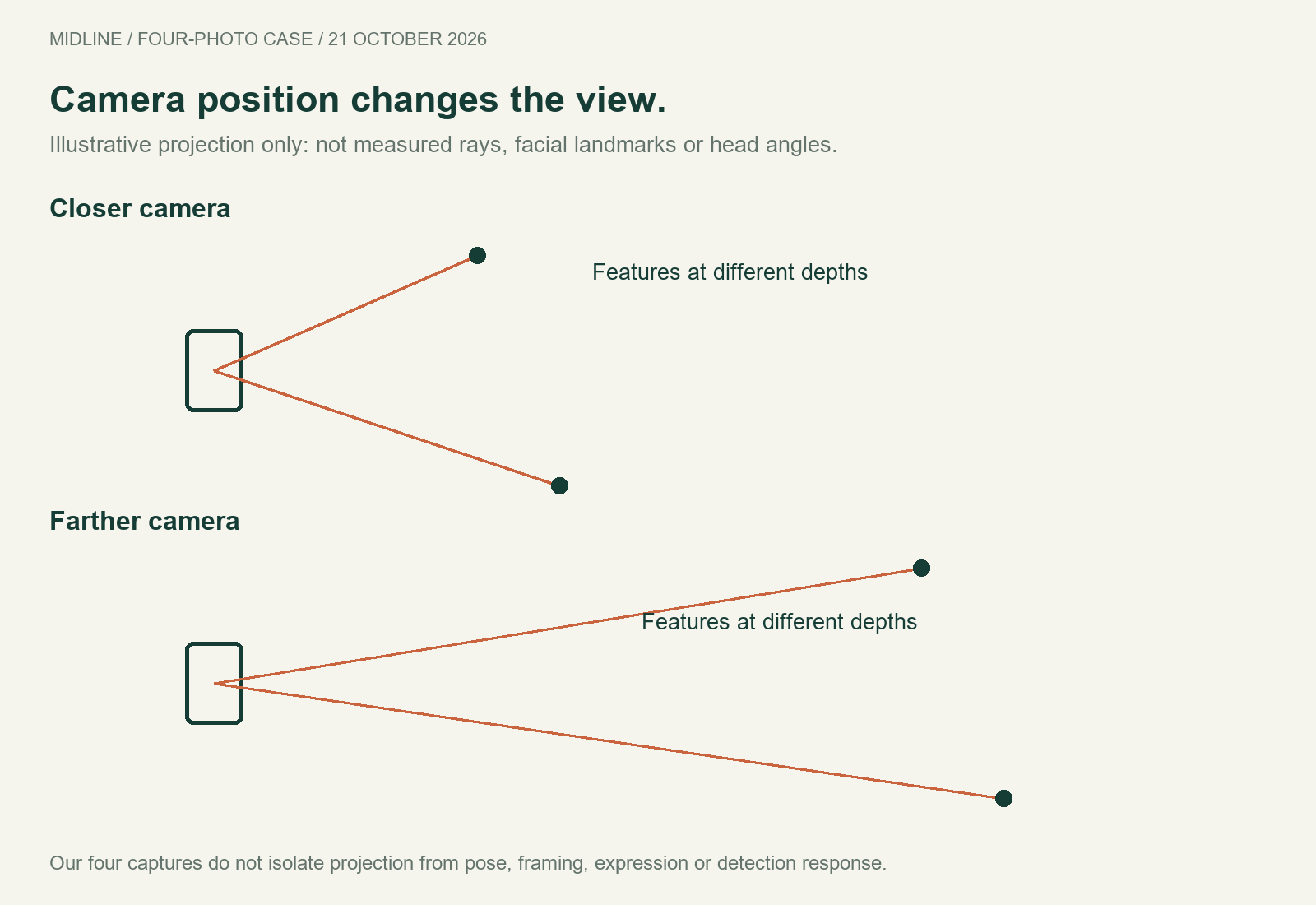
Our captures are an observational case, not an isolated projection experiment. Camera height, lens/zoom settings and exact distances were not logged. Framing, expression and glasses reflections may differ between pictures. Pose and the detector’s response are also involved. The scores alone cannot tell us which factor contributed how much.
The repeated values establish only that this browser returned the same displayed result for each unchanged file in these attempts. They do not establish accuracy, show what other people notice, or predict another person’s results. We have no population sample or ground-truth landmark comparison here.
3. Aim for repeatable photos, not a “true face” score
For a more comparable input, face the camera directly, keep its height near eye level, use even light and a relaxed expression, and keep the same lens, mode and position between captures. A stand and timer can help you repeat a setup. Avoid beauty reshaping and check whether glasses glare or hair hides features. We have not validated a universally best distance for this tool.
Open the face symmetry test, inspect the landmark overlay and read the five features alongside the total. If the tool rejects a turned image, retake a front-on photo instead of treating the refusal as a low score. Neither the higher-scoring picture nor the farther picture is automatically a more truthful representation of your face.
Try the photo-based analyzer ↗This measures image-based geometric symmetry. It is not a beauty rating, diagnosis or medical assessment. No correction technique, treatment effect or guaranteed result is offered.
Evidence and scope
Raw observations and capture notes support this page’s numeric comparisons. Reddit supplies attributed personal concerns only. For a separate same-file test, see our page-reload repeatability experiment. None of these records defines a normality threshold or proves that score changes equal physical facial change.