BROW FIELD / 28 OCTOBER 2026
One Eyebrow Higher Than the Other in Photos
If one eyebrow looks higher than the other in a photograph, this tool cannot tell you its physical cause or measure the height difference. It compares detected photo geometry. Before interpreting the eyebrow score, check the image and overlay: our fixed-portrait files returned eyebrow readings from 97.8 to 98.9 after processing changes, without a new photograph.
Watch the eyebrow-field comparison
English transcript
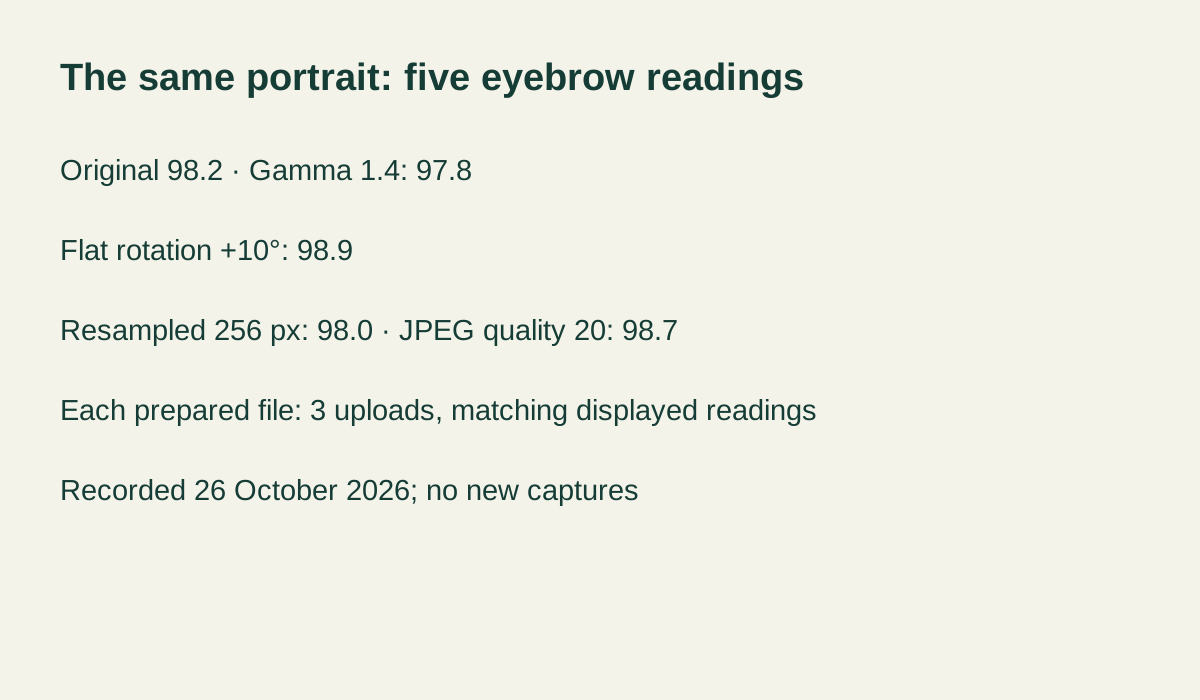
A higher looking eyebrow in a photo is not a height measurement from this tool. The eyebrow score describes estimated image geometry, not which side is physically higher. Before reading that number, check the original picture and the detected markers. We reused one fixed portrait recorded on October twenty sixth. Five prepared files were each uploaded three times. The unchanged eyebrow reading was 98.2. Darkening returned 97.8, and a flat ten degree rotation returned 98.9. A smaller copy returned 98.0, while a compressed JPEG returned 98.7. The compressed copy raised the eyebrow field by 0.5 points, but lowered the overall score by 0.5. Those two outputs answer different questions. The rotation was a file edit, not a head turn. Resizing was not a change in camera distance. Ten separate uploads of the unchanged baseline all displayed eyebrows at 98.2. That gives an observed displayed range of 0.0, not proof of zero detector noise. We did not save raw coordinates or measure a physical height gap. Use the original file, inspect the overlay, and keep capture conditions consistent. Read the full repeated observations on the eyebrow page at My Face Symmetry. This is photo geometry, not a beauty rating or a medical assessment.
What to check in the photograph first
Look at whether your head and camera are level, whether the expression matches the comparison photo, and whether light or an edit changes the visible brow boundary. Keep those capture conditions consistent rather than selecting the picture with the highest score. Our records below test prepared files; they do not isolate expression, physical lighting or a three-dimensional head turn.
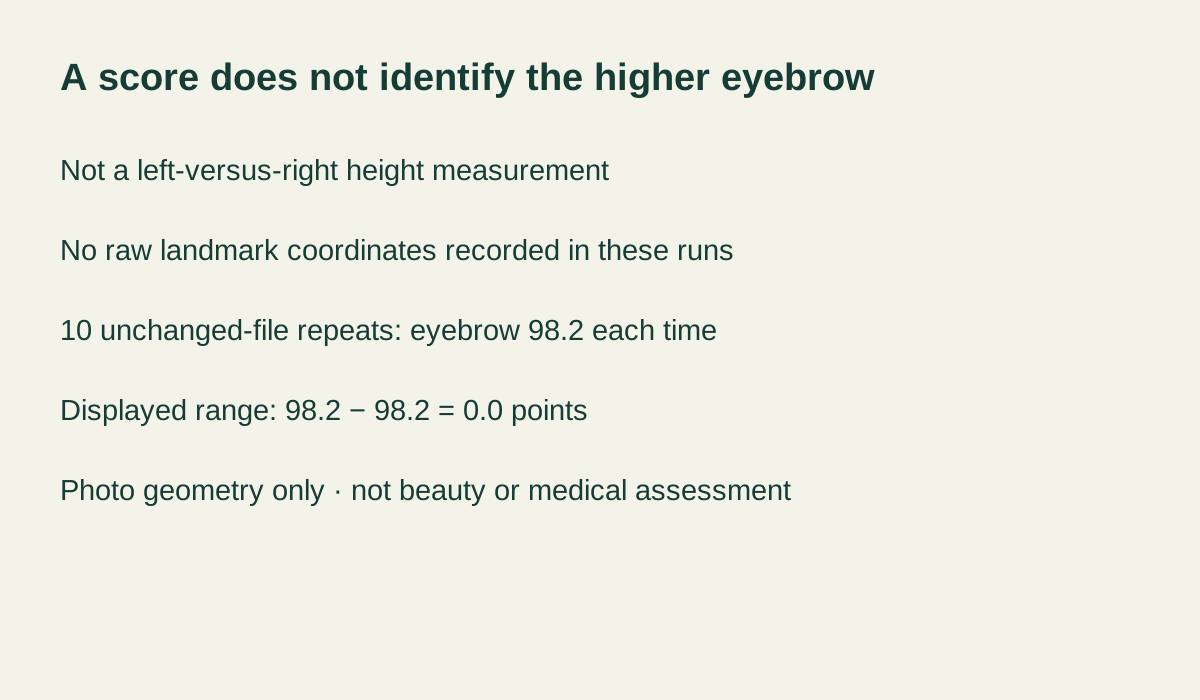
The eyebrow field does not label which brow is higher. We did not save raw landmark coordinates in these runs, so we cannot turn its 0–100 output into a millimetre gap, a left-or-right label or a physical explanation. Inspect the displayed markers alongside the original image instead of treating a single number as that answer.
Our existing file comparison, with every repeat
These observations were recorded on 26 October 2026 and reused on 28 October. One public portrait supplied five prepared files. Each was uploaded three times in the same Chrome session. They are 15 uploads of one portrait, not 15 people, and no new measurement was made for this article.
| Date | Prepared input | Repeat | Eyebrows | Overall |
|---|---|---|---|---|
| 2026-10-26 | Unchanged 512×512 PNG | 1 | 98.2 | 98.0 |
| 2026-10-26 | Unchanged 512×512 PNG | 2 | 98.2 | 98.0 |
| 2026-10-26 | Unchanged 512×512 PNG | 3 | 98.2 | 98.0 |
| 2026-10-26 | Gamma 1.4 darkening | 1 | 97.8 | 97.6 |
| 2026-10-26 | Gamma 1.4 darkening | 2 | 97.8 | 97.6 |
| 2026-10-26 | Gamma 1.4 darkening | 3 | 97.8 | 97.6 |
| 2026-10-26 | +10° flat rotation | 1 | 98.9 | 98.1 |
| 2026-10-26 | +10° flat rotation | 2 | 98.9 | 98.1 |
| 2026-10-26 | +10° flat rotation | 3 | 98.9 | 98.1 |
| 2026-10-26 | 256×256 LANCZOS PNG | 1 | 98.0 | 98.1 |
| 2026-10-26 | 256×256 LANCZOS PNG | 2 | 98.0 | 98.1 |
| 2026-10-26 | 256×256 LANCZOS PNG | 3 | 98.0 | 98.1 |
| 2026-10-26 | JPEG quality 20, subsampling 2 | 1 | 98.7 | 97.5 |
| 2026-10-26 | JPEG quality 20, subsampling 2 | 2 | 98.7 | 97.5 |
| 2026-10-26 | JPEG quality 20, subsampling 2 | 3 | 98.7 | 97.5 |
The unchanged file returned 98.2 for eyebrows and 98.0 overall in all three uploads. Gamma 1.4 darkening returned 97.8 and 97.6: eyebrow difference 97.8−98.2=−0.4. Gamma changes pixel tone; it is not a measurement of moving a light source.
The +10° flat rotation returned eyebrows 98.9 and total 98.1 each time. The eyebrow difference was 98.9−98.2=+0.7. This preparation used interpolation on a fixed canvas; it did not turn the participant’s head or raise an eyebrow.
The LANCZOS 256×256 PNG returned eyebrows 98.0 and total 98.1 each time: 98.0−98.2=−0.2 for eyebrows. Resizing the file did not change camera distance. The JPEG quality 20 copy with subsampling 2 returned eyebrows 98.7 and total 97.5 on every upload: 98.7−98.2=+0.5 for eyebrows.
Why a higher eyebrow score is not a lower eyebrow
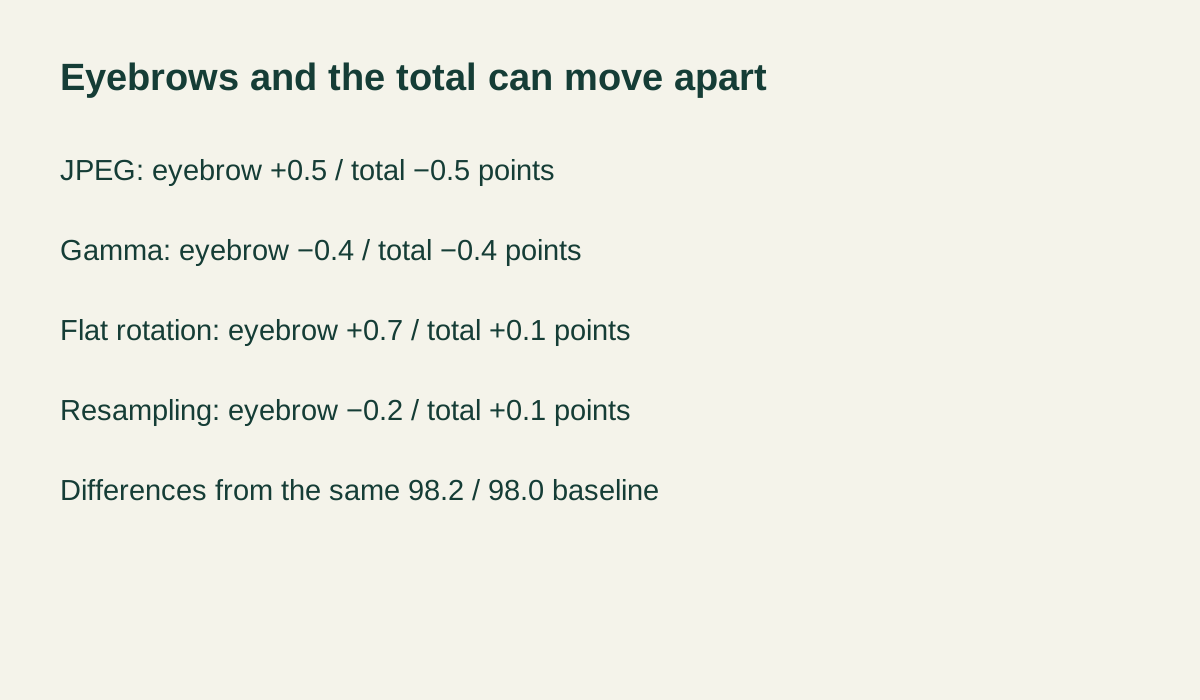
The JPEG example raised the eyebrow score by 0.5 while lowering the total by 0.5. The rotated file raised eyebrows by 0.7 while raising the total by only 0.1. Neither comparison tells us which side looked higher. The two fields are separately recorded outputs; using the total as a substitute would hide these differences.
Across the five conditions, max(98.2,97.8,98.9,98.0,98.7)−min(98.2,97.8,98.9,98.0,98.7)=1.1 eyebrow points. That range describes these prepared files only. It is not a normal range, an accuracy estimate or a promise about another face.
What the unchanged-file check adds
In a separate tab on 26 October, ten uploads of the unchanged baseline each returned eyebrows 98.2. The displayed repeat range was max(98.2,…,98.2)−min(98.2,…,98.2)=0.0. The four nonzero eyebrow differences above exceed that observed displayed range. Rounding to one decimal place still limits what this comparison can reveal; 0.0 does not prove zero detector noise.
Use the image, overlay and field together
Open the face symmetry test with the unedited original. Check that the detected brow markers sit on the visible brow area. Read the eyebrow field rather than borrowing the overall score. To check repeatability, upload that exact file again; a different capture introduces a different comparison.
For the larger photo-variable picture, use our photo variables table. Our eye-field comparison answers a separate question: the eye output is not the eyebrow output. This tool measures photo-based geometry, not beauty and not a medical assessment.
Three questions about a higher-looking eyebrow
Does the score tell me which eyebrow is higher?
No. The saved eyebrow field is one index, not a signed left-minus-right height. These records contain no raw-coordinate height comparison.
Did compression physically raise the brow in the test?
No new photograph was taken. The JPEG copy changed the displayed eyebrow reading from 98.2 to 98.7. That is a file-processing observation, not a measured physical movement.
Can I convert the eyebrow score into millimetres?
These observations provide no physical calibration or millimetre conversion. A numerical score must not be presented as a measured height gap.
Read the saved observations
All 15 file uploads and ten unchanged-file repeats retain the five feature fields and totals. The original field-by-field audit explains the comparison rule and its limits.