TONE CURVES / 24 OCTOBER 2026
Asymmetrical face test: can a tone edit change the score?
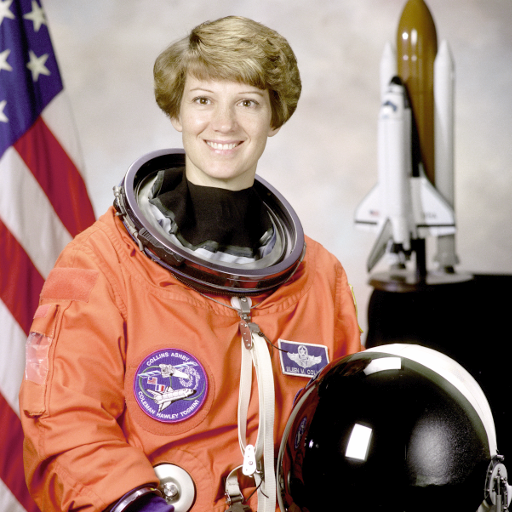
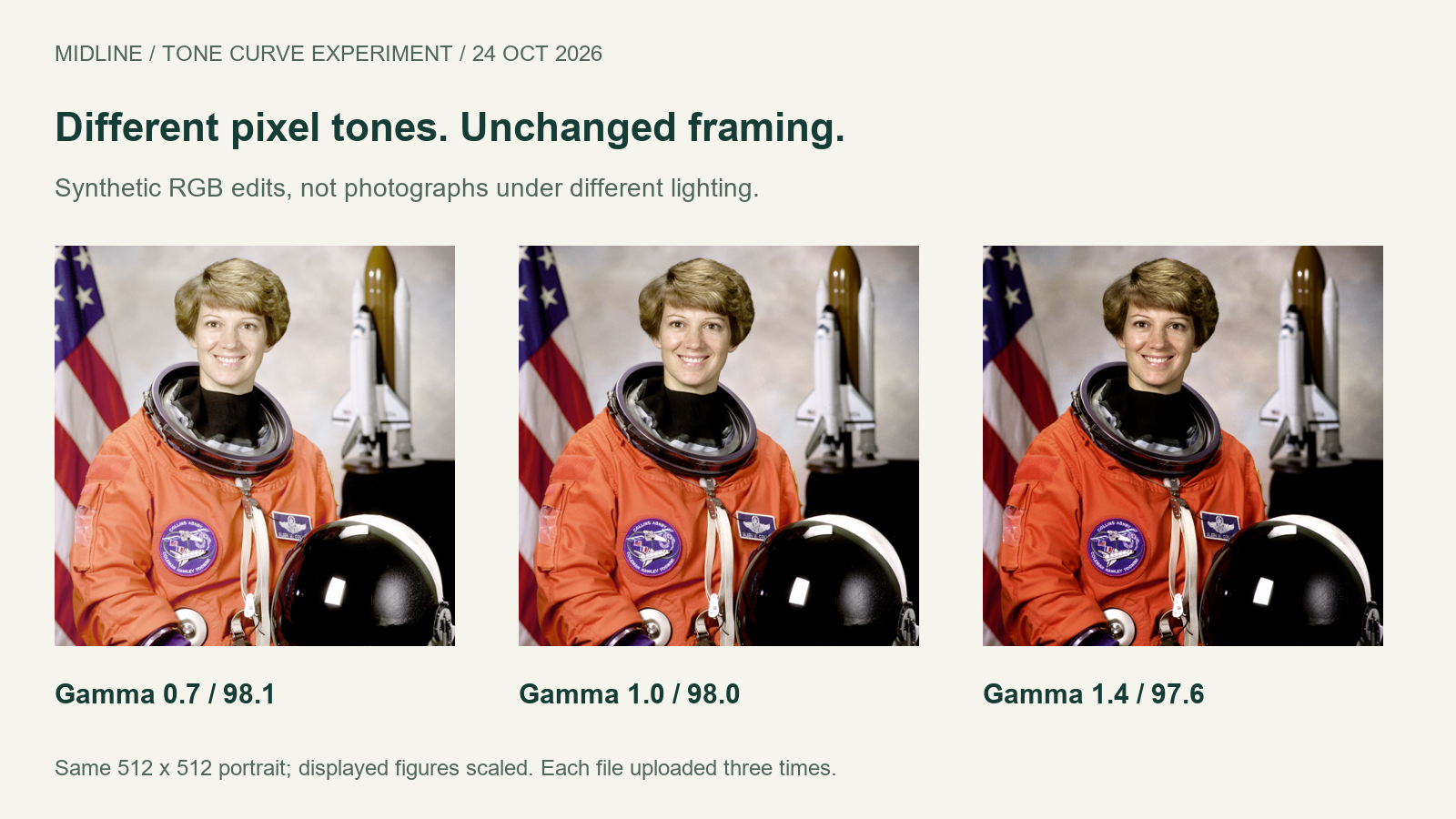
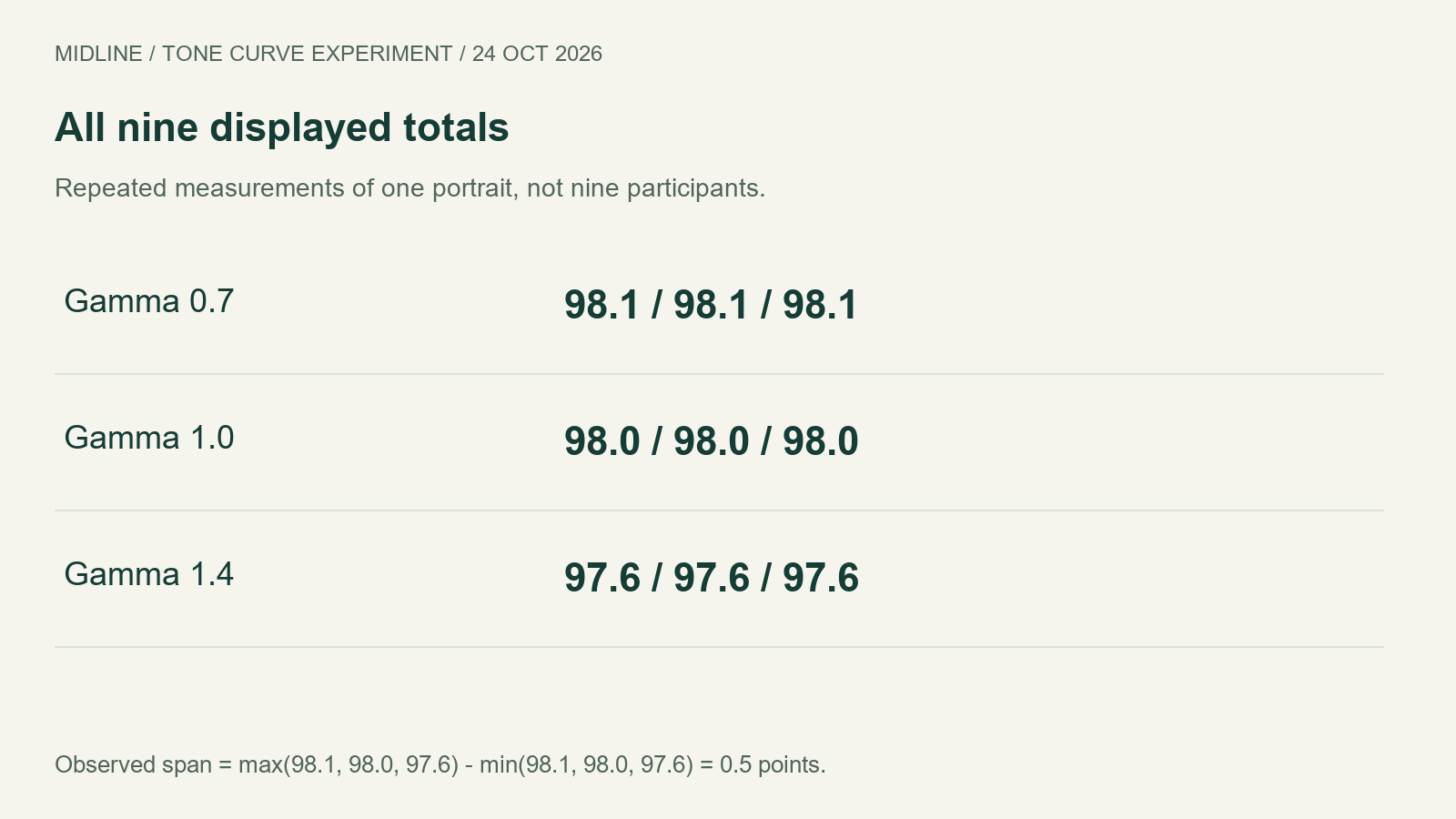
Yes, for this portrait: synthetic gamma settings 0.7, 1.0 and 1.4 returned 98.1, 98.0 and 97.6 overall. Each file was uploaded three times and its displayed results matched across repeats. The framing stayed fixed; the pixel tones changed. This does not show that your face changed or establish how real lighting affects everyone.
The question: did the face change, or the input?
A different reading can be unsettling when you are comparing pictures of yourself. This experiment asks a narrower question: can a global tone edit change the output while the portrait geometry and framing are held fixed? No new Reddit quotation or human lighting study is presented here.
We used one public astronaut portrait at 512 × 512 pixels. We applied a separate curve to each RGB channel: output = round(255 × (input / 255)^gamma). The chosen gamma values were 0.7, 1.0 and 1.4; they are experimental settings, not acceptable-asymmetry thresholds.
Gamma 1.0 was the preplanned unmodified control. We did not resize, crop, rotate or mirror these files, and all were saved as lossless PNG. A synthetic channel curve is not a calibrated change in camera exposure or room illumination.
Nine uploads, every feature recorded
On 24 October 2026, we uploaded gamma 0.7 three times, then gamma 1.0 three times, then gamma 1.4 three times in one original Chrome tab on Windows. Each attempt completed successfully. The detector was reused in that session; values below are the rendered one-decimal outputs.
| Gamma | Repeat | Overall | Eyes | Eyebrows | Nose | Mouth | Jaw |
|---|---|---|---|---|---|---|---|
| 0.7 | 1 | 98.1 | 98.6 | 98.2 | 97.6 | 97.4 | 98.5 |
| 0.7 | 2 | 98.1 | 98.6 | 98.2 | 97.6 | 97.4 | 98.5 |
| 0.7 | 3 | 98.1 | 98.6 | 98.2 | 97.6 | 97.4 | 98.5 |
| 1 | 1 | 98.0 | 98.0 | 98.2 | 98.2 | 97.1 | 98.6 |
| 1 | 2 | 98.0 | 98.0 | 98.2 | 98.2 | 97.1 | 98.6 |
| 1 | 3 | 98.0 | 98.0 | 98.2 | 98.2 | 97.1 | 98.6 |
| 1.4 | 1 | 97.6 | 98.1 | 97.8 | 98.1 | 96.2 | 98.1 |
| 1.4 | 2 | 97.6 | 98.1 | 97.8 | 98.1 | 96.2 | 98.1 |
| 1.4 | 3 | 97.6 | 98.1 | 97.8 | 98.1 | 96.2 | 98.1 |
All three repeats matched within each setting at the displayed precision. The overall span was 0.5 points: max(98.1, 98.0, 97.6) − min(98.1, 98.0, 97.6). Those inputs come directly from the table; this is a range within this test, not an accuracy estimate.
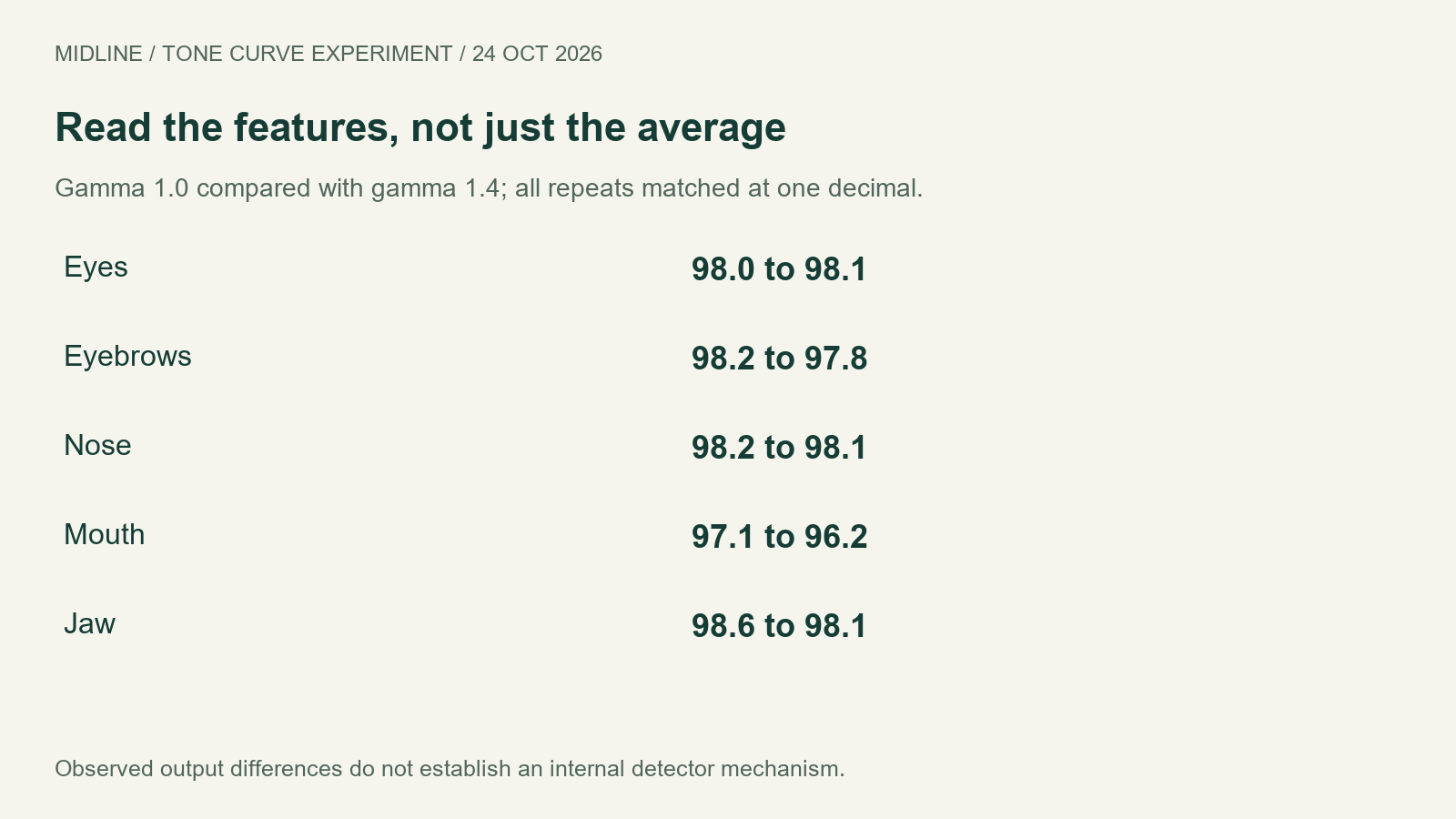
The mouth field changed from 97.1 at gamma 1.0 to 96.2 at gamma 1.4: 96.2 − 97.1 = −0.9 points. Eyes changed from 98.0 to 98.1 in that same comparison, while the overall changed from 98.0 to 97.6. A single average conceals these different directions.
What the observation supports
For these exact inputs and this implementation, the output was not invariant to global pixel-tone edits. The experiment records outputs; it does not identify the internal landmark shifts or prove that a particular detector stage caused the changes.
One portrait cannot establish a typical sensitivity, a safe gamma setting, a population ranking or clinical accuracy. Identical rounded repeats do not establish identical underlying coordinates. We did not photograph the person again, test side lighting or measure illumination.
This is distinct from our resampling experiment, which changed image dimensions, and the capture-distance case, which used different photographs. Keep those variables separate when reading the results.
Keep your comparison useful
Use the same original file when checking repeatability. For a new capture, keep camera position, expression and light consistent; avoid beauty reshaping or tone edits between pictures. Check the landmark overlay and feature readings as well as the total.
The photo-variable comparison table brings our other experiments together. Try the face symmetry test with a clear, straight-on input. It measures photo-based geometry, not beauty, and is not a medical assessment.
Direct answers
Did this test change the portrait geometry?
The prepared files kept the same pixel grid and framing; only their RGB values were transformed. Yet the three input totals differed in our observations.
Does a lower result prove more facial asymmetry?
It reports a different output for a different input. These edits do not demonstrate a change in anatomy, attractiveness or what another person sees.
Can this tell me how to light every photo?
No. A synthetic global curve is not directional light. The study cannot establish a universal capture or correction rule.
Watch the tone-curve experiment
English transcript
Inputs and sources
Primary evidence: all nine observations, protocol and app/model hashes. Portrait provenance: scikit-image astronaut dataset documentation, derived from NASA imagery. No private photograph was used.