PHOTO QUESTIONS / 27 OCTOBER 2026
My Face Is Not Symmetrical: What Changed Between the Photos?
If your face looks less symmetrical in one photo, changed capture conditions or image processing can change the appearance and the score without your face changing. Our saved tests show both score changes and refused measurements. They do not establish that every visible difference is caused by a camera, or explain an individual person’s anatomy.
A short walkthrough
Video walkthrough — reading version
Different capture conditions or file edits can move a symmetry reading without a physical change in the person. A photo that feels unfamiliar can make you question which version to trust. Our saved records separate a new camera capture from a processed copy of an existing image. The camera case used four pictures of one participant, with three attempts per picture. The near frontal picture returned 98.6 each time. The far frontal picture returned 96.1. Both turned pictures were rejected on every attempt. No returned number means no measured score, rather than a lower rating. The color case used a different source portrait, so it cannot be combined with that participant as one experiment. Original color, reduced saturation, and grayscale each went through three uploads. The totals were 98.0, 97.8, and 96.4. The mouth moved from 97.1 to 93.6. Those are differences between prepared image files. They do not show a change in the photographed person, or explain which internal landmark moved. When making a comparison, first decide whether you changed the capture or the file. For a new picture, repeat your camera setup and keep a relaxed, front facing pose. For repeated uploads, use the original file and retain any refusal message. These records describe photo geometry, without providing a beauty grade or a medical evaluation.
“My face is not symmetrical” can begin with a photograph
A Reddit author wrote: So i started noticing i have asymmetrical face when i look at the photos clicked on back camera
. The original post was published on 29 June 2026, 05:33:49 UTC. The quotation and original timestamp were verified on 21 October 2026; this is a personal account, not controlled evidence that a rear camera causes asymmetry.
The useful next question is narrower than “which picture is the real me?” Ask what changed between the two inputs, and whether both were measured at all. The two existing cases below separate a new capture from an edited file. They involve different source portraits and must not be pooled into a single-person experiment.
Case one: a changed capture can change the reading—or stop it
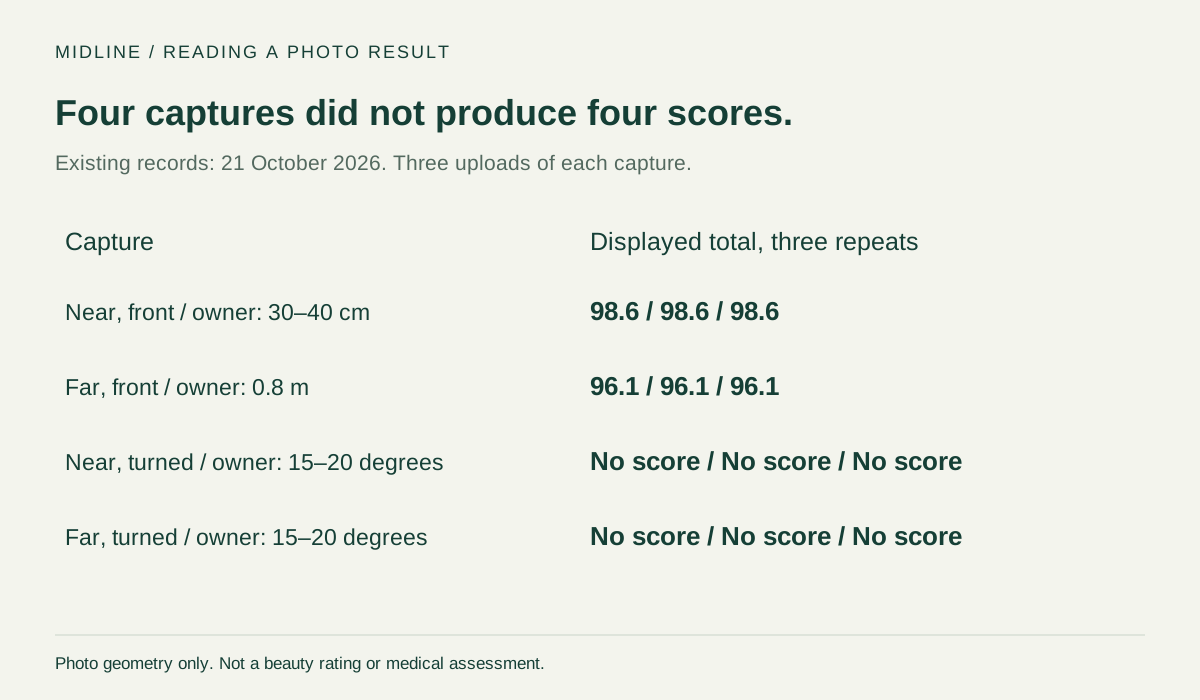
On 21 October 2026, we uploaded four owner-supplied captures of one consenting participant three times each: 12 attempts. The owner reported near distance as 30–40 cm, far distance as about 0.8 m, and the turned views as about 15–20 degrees. Those are owner-reported capture notes, not measurements made by this website.
| Date | Capture / file | Repeat | Total | Eyes | Brows | Nose | Mouth | Jaw | Status |
|---|---|---|---|---|---|---|---|---|---|
| 2026-10-21 | Far / turned | 1 | — | — | — | — | — | — | Your head appears turned. Use a photo facing straight toward the camera. |
| 2026-10-21 | Far / turned | 2 | — | — | — | — | — | — | Your head appears turned. Use a photo facing straight toward the camera. |
| 2026-10-21 | Far / turned | 3 | — | — | — | — | — | — | Your head appears turned. Use a photo facing straight toward the camera. |
| 2026-10-21 | Far / front | 1 | 96.1 | 95.5 | 97.5 | 96.6 | 98.1 | 92.5 | Analysis complete. Try another photo under the same conditions. |
| 2026-10-21 | Far / front | 2 | 96.1 | 95.5 | 97.5 | 96.6 | 98.1 | 92.5 | Analysis complete. Try another photo under the same conditions. |
| 2026-10-21 | Far / front | 3 | 96.1 | 95.5 | 97.5 | 96.6 | 98.1 | 92.5 | Analysis complete. Try another photo under the same conditions. |
| 2026-10-21 | Near / turned | 1 | — | — | — | — | — | — | Your head appears turned. Use a photo facing straight toward the camera. |
| 2026-10-21 | Near / turned | 2 | — | — | — | — | — | — | Your head appears turned. Use a photo facing straight toward the camera. |
| 2026-10-21 | Near / turned | 3 | — | — | — | — | — | — | Your head appears turned. Use a photo facing straight toward the camera. |
| 2026-10-21 | Near / front | 1 | 98.6 | 99.0 | 98.5 | 98.6 | 98.0 | 99.1 | Analysis complete. Try another photo under the same conditions. |
| 2026-10-21 | Near / front | 2 | 98.6 | 99.0 | 98.5 | 98.6 | 98.0 | 99.1 | Analysis complete. Try another photo under the same conditions. |
| 2026-10-21 | Near / front | 3 | 98.6 | 99.0 | 98.5 | 98.6 | 98.0 | 99.1 | Analysis complete. Try another photo under the same conditions. |
Both frontal captures produced six-field results on all three uploads. Near-front totals were 98.6, 98.6 and 98.6; far-front totals were 96.1, 96.1 and 96.1. The displayed difference was 98.6 − 96.1 = 2.5 points. The mouth was 98.0 near and 98.1 far: it moved in the opposite direction to the overall score.
The near-front jaw reading was 99.1 and far-front was 92.5, a displayed gap of 99.1 − 92.5 = 6.6 points. That does not isolate distance as the cause: these were separate captures, with possible differences in expression, pose and visibility. We did not establish a “best” distance or a reference anatomical measurement.
Both turned captures returned Your head appears turned. Use a photo facing straight toward the camera.
on all three attempts. There is no turned-view score to subtract. Calling that refusal a lower symmetry result would invent data.
The complete capture context remains in the camera-position case. This page uses its outcomes to distinguish a changed value from an unavailable value.
Case two: the same captured face, a differently processed file
On 26 October 2026, a separate experiment used one public portrait saved as 512 × 512 RGB PNG files. Color saturation factors were 1, 0.5 and 0; each file was uploaded three times. There was no new camera capture in this case. These are the nine existing records, not nine new measurements made today.
| Date | Capture / file | Repeat | Total | Eyes | Brows | Nose | Mouth | Jaw | Status |
|---|---|---|---|---|---|---|---|---|---|
| 2026-10-26 | saturation-1.png | 1 | 98.0 | 98.0 | 98.2 | 98.2 | 97.1 | 98.6 | Analysis complete. Try another photo under the same conditions. |
| 2026-10-26 | saturation-1.png | 2 | 98.0 | 98.0 | 98.2 | 98.2 | 97.1 | 98.6 | Analysis complete. Try another photo under the same conditions. |
| 2026-10-26 | saturation-1.png | 3 | 98.0 | 98.0 | 98.2 | 98.2 | 97.1 | 98.6 | Analysis complete. Try another photo under the same conditions. |
| 2026-10-26 | saturation-0.5.png | 1 | 97.8 | 98.5 | 98.1 | 97.4 | 96.7 | 98.4 | Analysis complete. Try another photo under the same conditions. |
| 2026-10-26 | saturation-0.5.png | 2 | 97.8 | 98.5 | 98.1 | 97.4 | 96.7 | 98.4 | Analysis complete. Try another photo under the same conditions. |
| 2026-10-26 | saturation-0.5.png | 3 | 97.8 | 98.5 | 98.1 | 97.4 | 96.7 | 98.4 | Analysis complete. Try another photo under the same conditions. |
| 2026-10-26 | saturation-0.png | 1 | 96.4 | 96.9 | 97.5 | 97.3 | 93.6 | 96.5 | Analysis complete. Try another photo under the same conditions. |
| 2026-10-26 | saturation-0.png | 2 | 96.4 | 96.9 | 97.5 | 97.3 | 93.6 | 96.5 | Analysis complete. Try another photo under the same conditions. |
| 2026-10-26 | saturation-0.png | 3 | 96.4 | 96.9 | 97.5 | 97.3 | 93.6 | 96.5 | Analysis complete. Try another photo under the same conditions. |
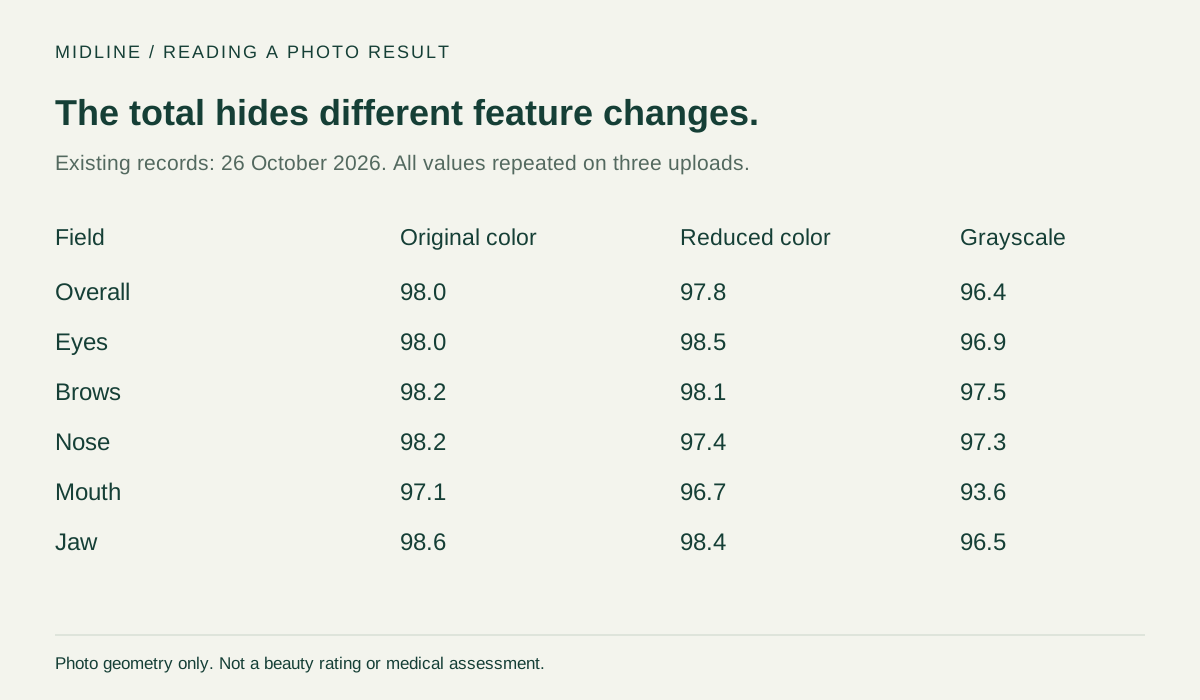
Totals were 98.0, 97.8 and 96.4 for original color, reduced saturation and grayscale respectively. Grayscale minus original was 96.4 − 98.0 = −1.6 points. Mouth readings were 97.1, 96.7 and 93.6, a grayscale change of 93.6 − 97.1 = −3.5 points.
For grayscale minus original, eyes changed by 96.9 − 98.0 = −1.1; brows by 97.5 − 98.2 = −0.7; nose by 97.3 − 98.2 = −0.9; jaw by 96.5 − 98.6 = −2.1 points. Every unchanged file repeated its displayed fields, but the fields did not move uniformly across files.
We changed the input colors, not the photographed person. This case shows different outputs for these files, without identifying an internal landmark cause or a physical change in a face. It also does not tell us how directional lighting or another face would behave.
The full saturation case records the preparation and limitations. Our separate repeated-file test measures displayed repeat ranges; its one-file result is not a universal error threshold for these captures.
What to do with your next comparison
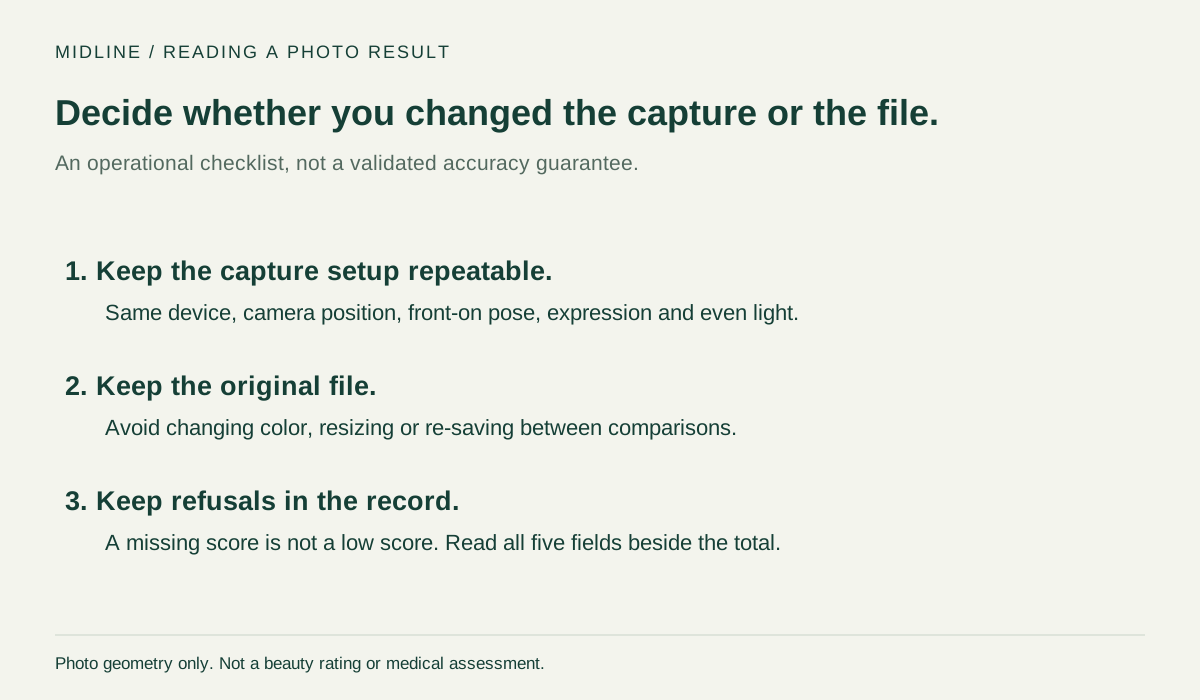
For a new photo, use a repeatable camera position, front-on pose, relaxed expression and even light. Keep the device and lens consistent; avoid placing the camera very close to the face. Our cases do not validate one universally correct distance.
For a same-file repeat, keep the exact original rather than a resized, color-edited or re-saved copy. Open the face symmetry test, inspect the overlay and record the total together with eyes, eyebrows, nose, mouth and jaw. If the tool refuses the input, record its message instead of choosing a different score.
The practical distinction is whether you changed the capture, changed the file, or received no measurement. Keep those three situations separate. This tool measures estimated photo geometry; it is not a beauty rating or medical assessment.
Evidence and dates
Published 27 October 2026. Evidence reused from 21 October capture records and 26 October saturation records. No new participant photos or experimental readings were created for this article. The Reddit account provides context only; no correction routine or promised effect is adopted.