COLOR SATURATION / 26 OCTOBER 2026
Beauty symmetry test: why a color edit is not a beauty verdict
A “beauty symmetry test” on this site measures photo geometry, not beauty. In our one-portrait color experiment, original color scored 98.0, reduced saturation scored 97.8, and grayscale scored 96.4. Each input repeated the same total and five feature readings across three uploads. The displayed total range was 1.6 points. We collected no attractiveness judgments, so these numbers cannot rank the beauty of the three versions.
A short walkthrough
English transcript
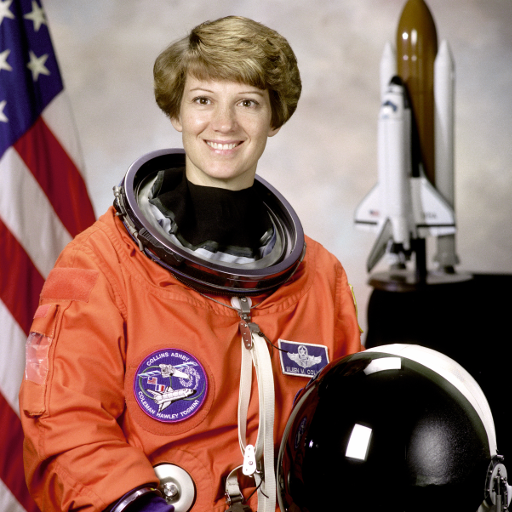
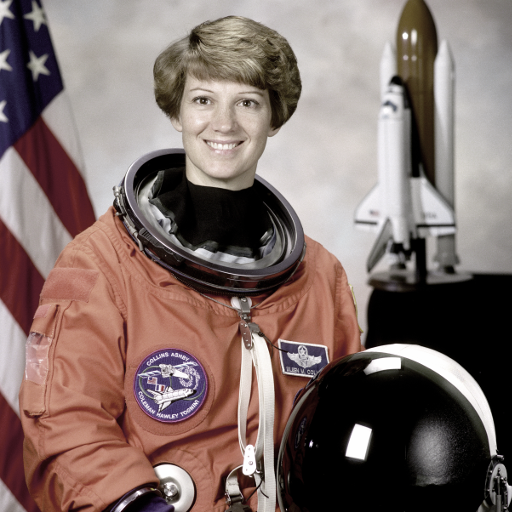
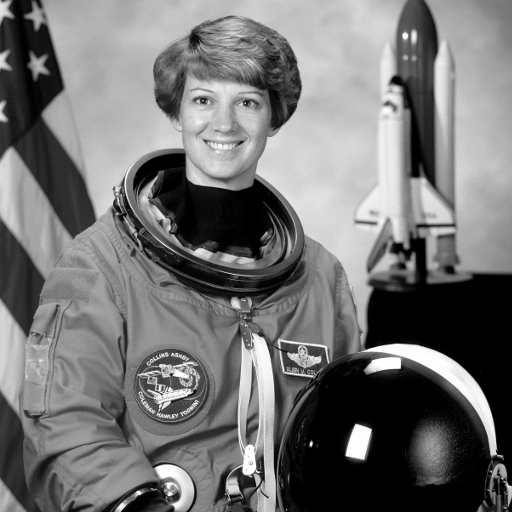
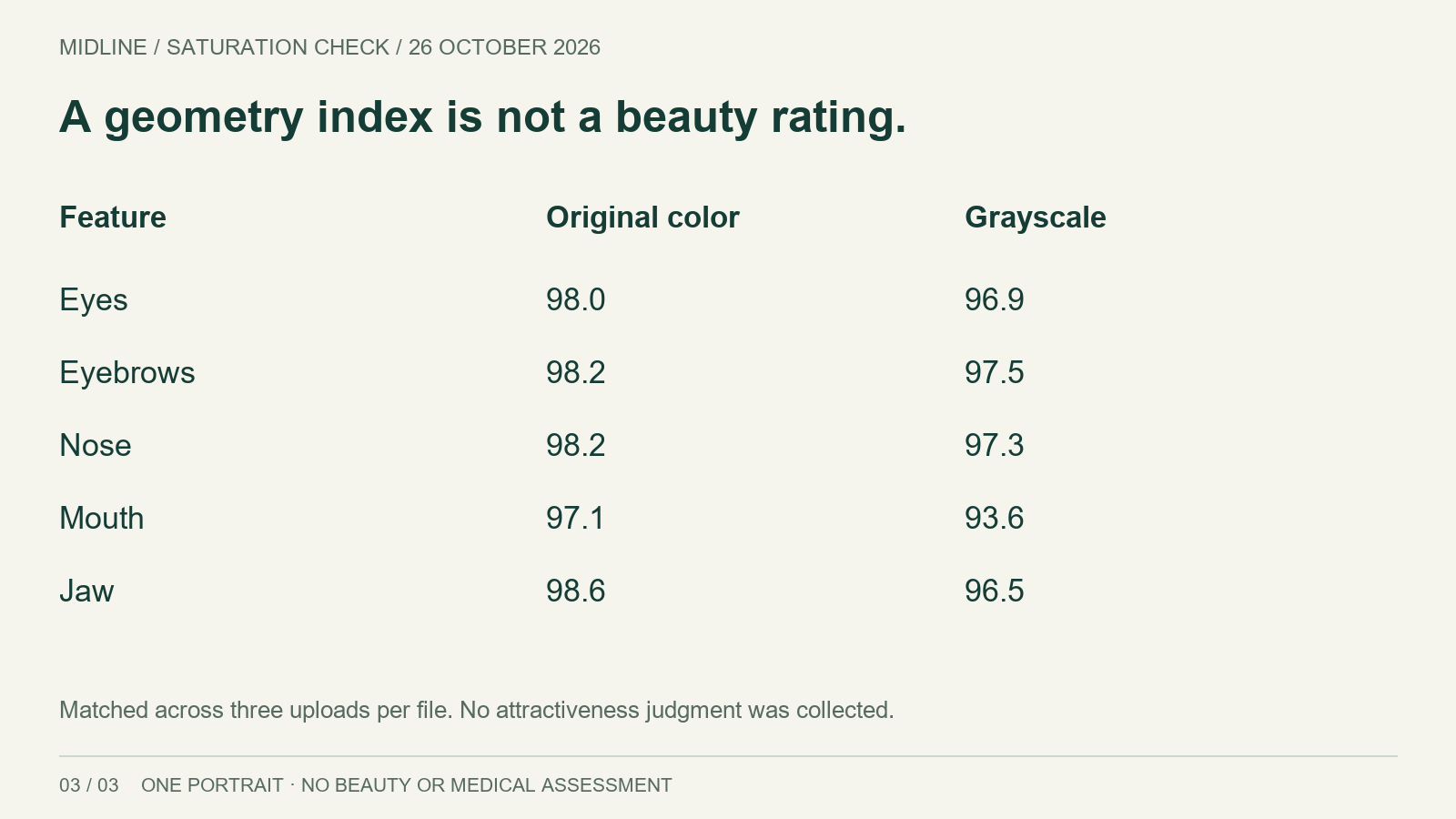
A photo geometry score is not a beauty rating. In our new test, changing color saturation changed the readings without changing the photographed person. We kept one public astronaut portrait at the same size and framing. We prepared the original color version, a reduced saturation version, and a grayscale version. All were saved as lossless PNG files. Each file was uploaded three times in the same Chrome tab. The original color total was ninety eight point zero on every upload. The reduced saturation total was ninety seven point eight. The grayscale total was ninety six point four. All five feature readings also repeated for each unchanged file. These were nine uploads of one portrait, not nine people. The largest displayed total minus the smallest was one point six score points. The mouth reading moved from ninety seven point one to ninety three point six between original color and grayscale. We did not ask people to rate beauty or collect any health assessments. The results cannot establish that one version is more attractive. Keep the original file when checking repeatability, and inspect the detected overlay. Read the full table on our site before interpreting a score.
A color edit, not a new face
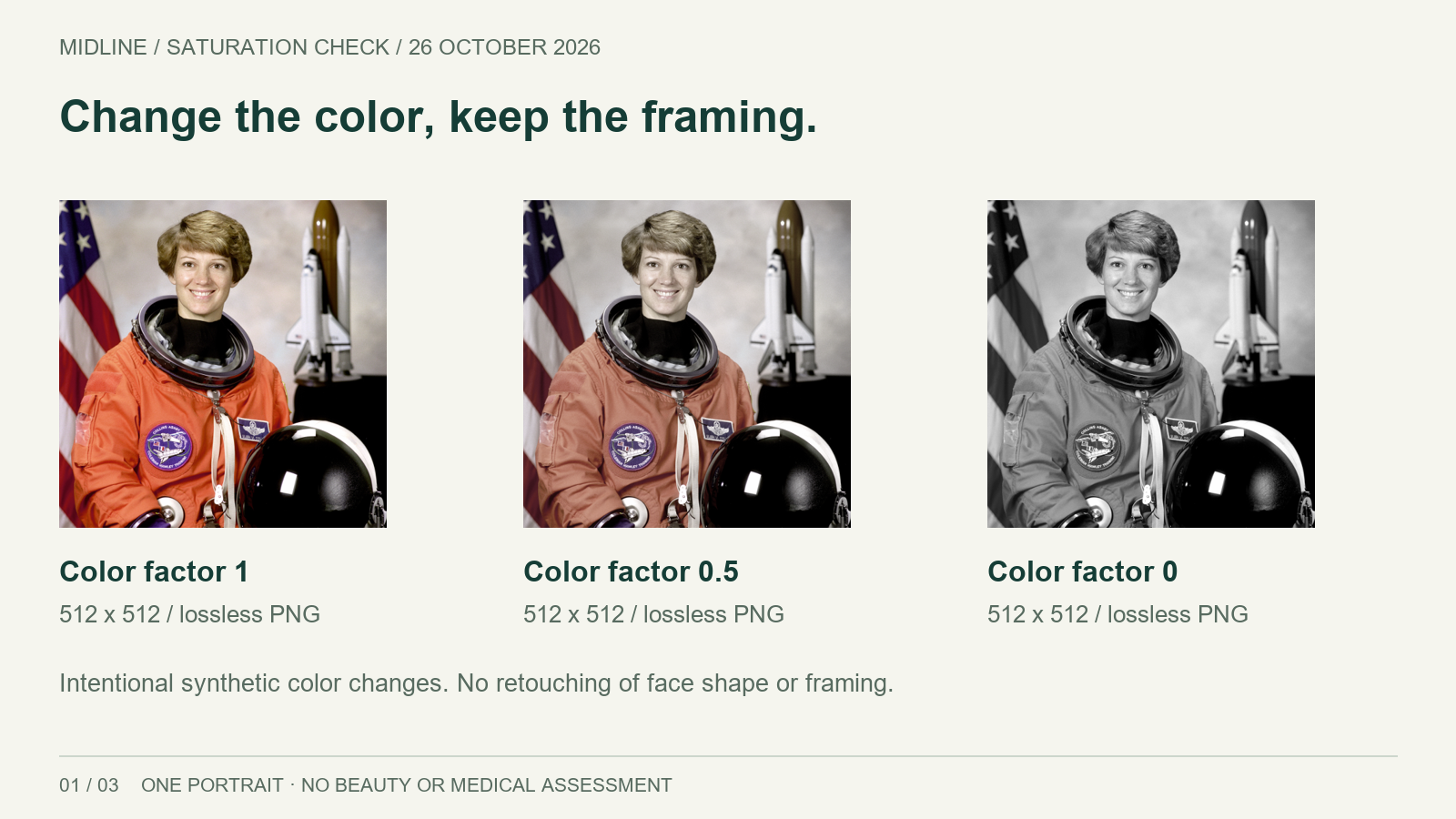
The files were prepared on 25 October, before today’s measurements. We used the same public 512 × 512 astronaut portrait as the other cases, changing only the Pillow Color enhancement factor: 1, 0.5 and 0. All outputs remained RGB PNG files with the same dimensions and no deliberate crop, rotation or face reshaping.
The Pillow Color documentation describes factor 1 as the original image and factor 0 as a black-and-white image. Factor 0.5 is a preparation setting, not a measured “50% change” in a face. This procedure does not hold every pixel’s luminance constant or isolate a particular internal detector mechanism.
We checked the prepared file hashes against the plan before publishing. The observation record includes dimensions, byte sizes, factor settings and the tested app/model hashes. Unlike our WebP experiment, this test did not deliberately change the file encoding family or compression quality.
All nine attempts, with every feature
| Input | Repeat | Overall | Eyes | Eyebrows | Nose | Mouth | Jaw |
|---|---|---|---|---|---|---|---|
| saturation-1.png | 1 | 98.0 | 98.0 | 98.2 | 98.2 | 97.1 | 98.6 |
| saturation-1.png | 2 | 98.0 | 98.0 | 98.2 | 98.2 | 97.1 | 98.6 |
| saturation-1.png | 3 | 98.0 | 98.0 | 98.2 | 98.2 | 97.1 | 98.6 |
| saturation-0.5.png | 1 | 97.8 | 98.5 | 98.1 | 97.4 | 96.7 | 98.4 |
| saturation-0.5.png | 2 | 97.8 | 98.5 | 98.1 | 97.4 | 96.7 | 98.4 |
| saturation-0.5.png | 3 | 97.8 | 98.5 | 98.1 | 97.4 | 96.7 | 98.4 |
| saturation-0.png | 1 | 96.4 | 96.9 | 97.5 | 97.3 | 93.6 | 96.5 |
| saturation-0.png | 2 | 96.4 | 96.9 | 97.5 | 97.3 | 93.6 | 96.5 |
| saturation-0.png | 3 | 96.4 | 96.9 | 97.5 | 97.3 | 93.6 | 96.5 |
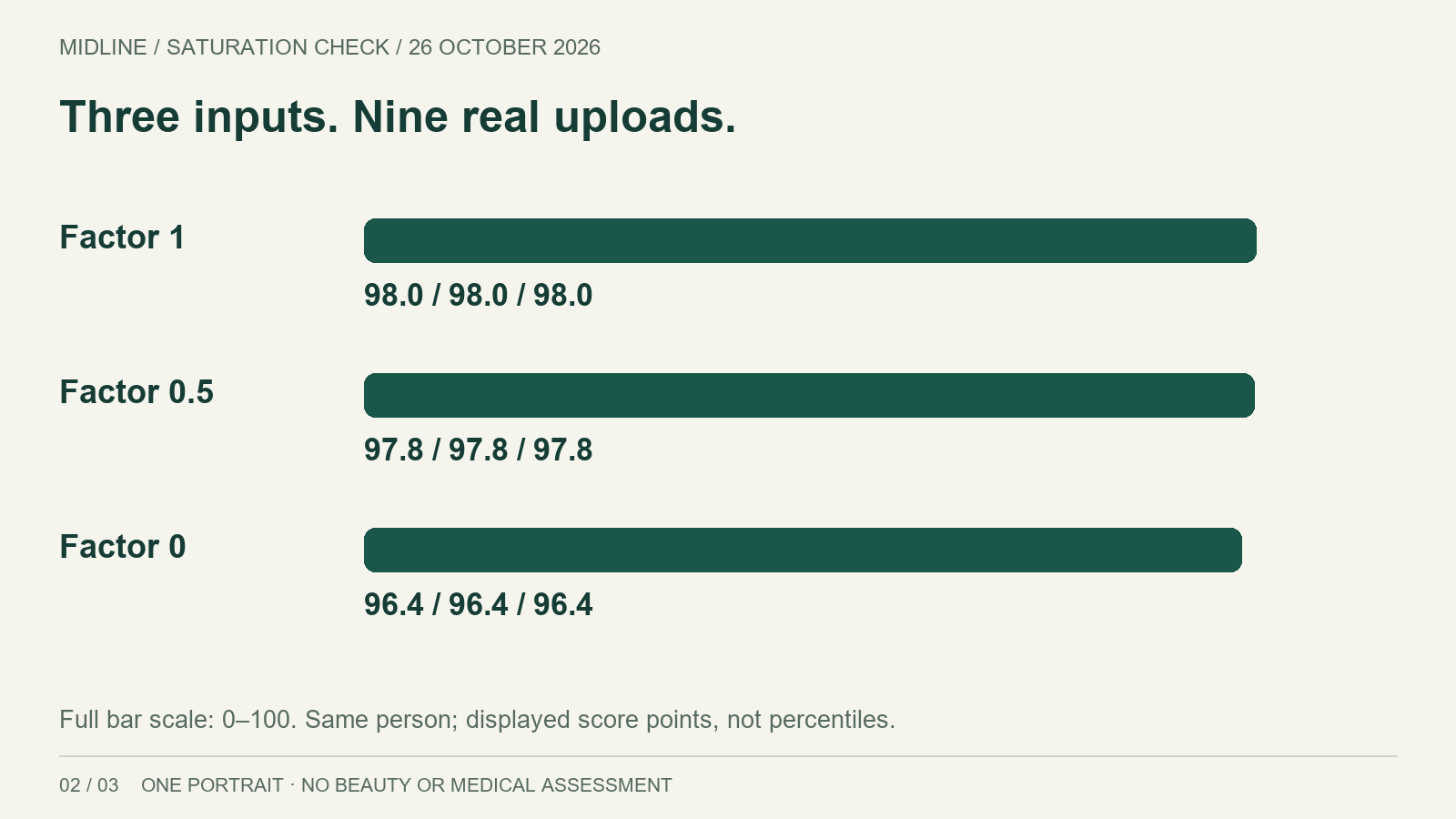
The overall range is max(98.0, 97.8, 96.4) − min(98.0, 97.8, 96.4) = 1.6 score points. Grayscale minus original color is 96.4 − 98.0 = −1.6 points. These are subtractions of the table’s displayed totals, not accuracy estimates.
For grayscale minus original color, mouth changed by 93.6 − 97.1 = −3.5 points, while eyebrows changed by 97.5 − 98.2 = −0.7. The five features did not move by a uniform amount. This is why we publish the breakdown instead of only the total.
What the repeated readings establish
We uploaded factor 1 three times, then factor 0.5 three times, then factor 0 three times in one production Chrome tab. Every attempt completed successfully. We recorded overall, eyes, eyebrows, nose, mouth and jaw after the completion message. Each unchanged file repeated all six fields at the shown precision.
The source picture stayed fixed, but decoded colors changed. The detector returned different displayed readings across these inputs. That establishes sensitivity in this small case; it does not establish that color alone caused a particular landmark to move, because landmark coordinates were not recorded in this run.
No new photographs, people, beauty-rating panel, medical measurements or ground-truth landmark annotations were added. The experiment cannot show that a higher score looks better, that desaturation always lowers scores, or that the output is accurate to a stated percentage.
Why “beauty” is outside this score
Our method overview distinguishes the input image from a permanent description of a person. The implementation compares reflected landmark pairs about a fitted midline and averages feature errors. It contains no human attractiveness-rating input. Reading its output as a beauty grade would add a claim that this experiment never tested.
The camera case shows a separate limitation: different capture conditions and turned-head refusals. Our same-file reload case asks about repeatability instead. A result can repeat for one file and still depend on how that file was made.
For a repeatability check, keep the exact original. For a new capture, keep device, camera position, expression and light consistent. Avoid color edits between comparisons, inspect the overlay and read all five feature fields. This makes the setup clearer; it does not produce a validated beauty or health measurement.
Try the photo geometry test ↗Questions and direct answers
Can a beauty symmetry test tell me how attractive I am?
This tool cannot. It measures estimated photo geometry and did not collect human beauty judgments. Our color inputs produced different scores without establishing any difference in attractiveness.
Did grayscale always score lower in this study?
The grayscale file scored 96.4 on its three uploads, below original color at 98.0 and reduced saturation at 97.8. This ordering applies to these inputs; it is not a general rule for every face or detector.
Does the same score on three uploads prove accuracy?
No. It records repeatability at the displayed precision for an unchanged file. Accuracy would require a suitable reference measurement, which this experiment did not supply.
Evidence and inputs
Full observations and hashes · Prepared plan · Original color · Reduced saturation · Grayscale. Source portrait: NASA astronaut Eileen Collins, distributed through scikit-image astronaut data. No private photographs were uploaded. The photo-variable guide links the earlier cases.